String 1–3 Triads in D Major
In this video
Triads In D - Acoustic Lesson Video
More helpful on screen graphics here and Full Acoustic lesson Page Here
D major is the perfect second key for triads, for one beautiful reason: the open D string. Every shape you learn in this lesson can ring over an open D pedal note — the trick behind She Sells Sanctuary by The Cult and so much of U2's biggest material — which means the root note is always sounding while your fingers are free to move. The shapes themselves are simply the C major shapes moved up two frets, so this lesson is as much about consolidation as new material. And to sell you the destination up front: the intro to Hole Hearted by Extreme, the easiest song you can learn with triads, is within reach by the end of this video.
What you will learn:
• The twelve-fret principle: playing what you already know, higher up the neck
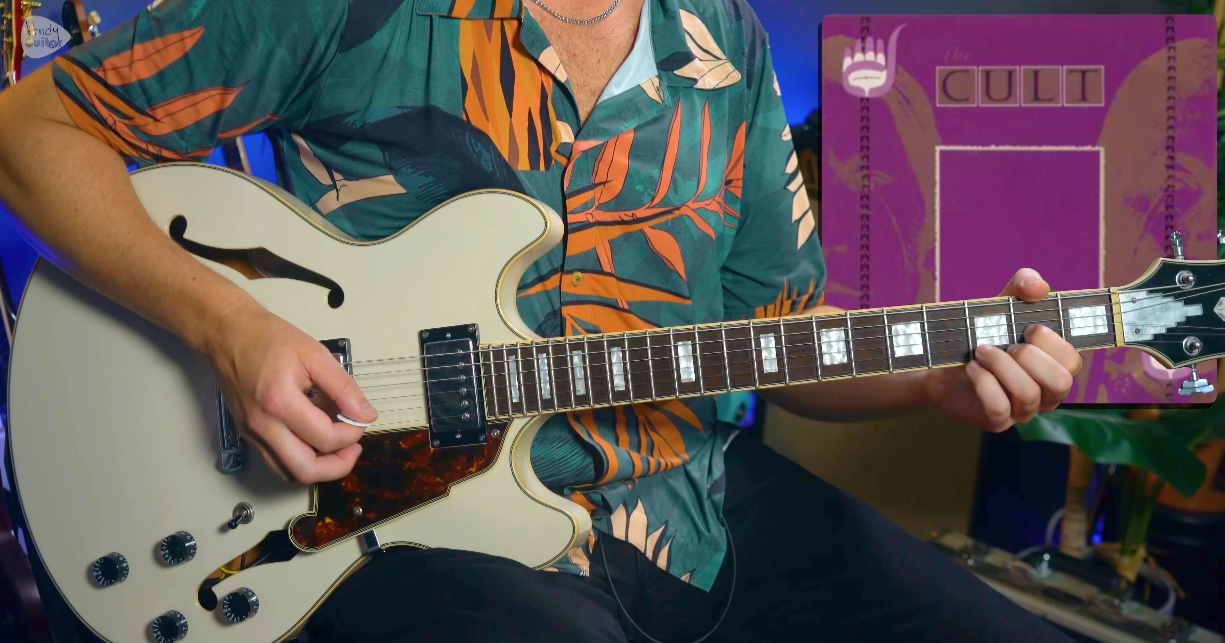
• The open D pedal note — She Sells Sanctuary and the power of a ringing root
• The three positions: tonic triad, the U2 position, and the D shape up the neck
• The With or Without You practice routine: bassline, triads and a delay pedal
• Hole Hearted: the easiest triad song, and your first real-world test
The Twelve-Fret Principle
First things first: get comfortable playing the open D chord shape twelve frets up, where everything repeats identically. A lot of fretboard and chord learning is actually learning to use things you technically already know — the knowledge isn't new, but the physical habit of playing it up there is. That reframe takes the fear out of the whole lesson: every D triad on the thinnest three strings is either a shape from the C major lesson moved up two frets, or a chord you've played for years relocated.
The Open D Pedal Note
A pedal note is a root that keeps ringing while the chords move above it — and the open D string is the guitar's great gift here. Move your D triad shapes around while the open string drones underneath and you get that deep, powerful, ringing sound that She Sells Sanctuary is built on, and that runs through so many classic songs. It's also a brilliant practice aid: the pedal note constantly reminds your ear where home is while your fingers hunt for the next shape.
The Three Positions
You already know D to Dsus4 and D to Dsus2 in open position — great songs are built on that alone. Up the neck: the thinnest three strings of your D barre chord at the fifth fret (five-seven-seven) give you the tonic triad — root, third, fifth. Then comes the position at ten-and-eleven, essentially the top of a D barre chord, which is flatly the U2 position: add a delay pedal and you're in Where the Streets Have No Name — The Edge does this constantly. Finally the D shape appears again further up, completing the set. Tonic, first inversion, second inversion: same logic as C, two frets higher.
The With or Without You Practice Routine
The best way to solidify D triads all over the neck: play the With or Without You bassline — just ten, five, seven, three on the D string — then answer each bass note with the nearest triad shape, add a delay, and let the open D ring where it can. Then push up to the first inversion, work in the sus4, maybe add a little chorus. It's one example of many — the point is that every practice loop should combine a moving bass idea with the shapes, because that's how they get used in real songs.
Hole Hearted and What Comes Next
The intro of Hole Hearted by Extreme — just the first few chords — is the easiest song you can learn with triads, and it really starts to sell what these shapes are for. Learn it, and use it as your measuring stick. Full song suggestions arrive at the end of the next video, because that's when you'll have enough chords under your fingers to play with more than one key per jam. There's tab linked below — have a play, and I'll see you in the next video when you're ready.
Intermediate Electric Level 6
Recommended Songs
Enjoying this course? Want to test out your new skills? Find out my recommended song tutorials that accompany this course and get total access to the site by signing up today!