
Learn all FIVE pentatonic shapes in E minor - Learn The Fretboard
In this video
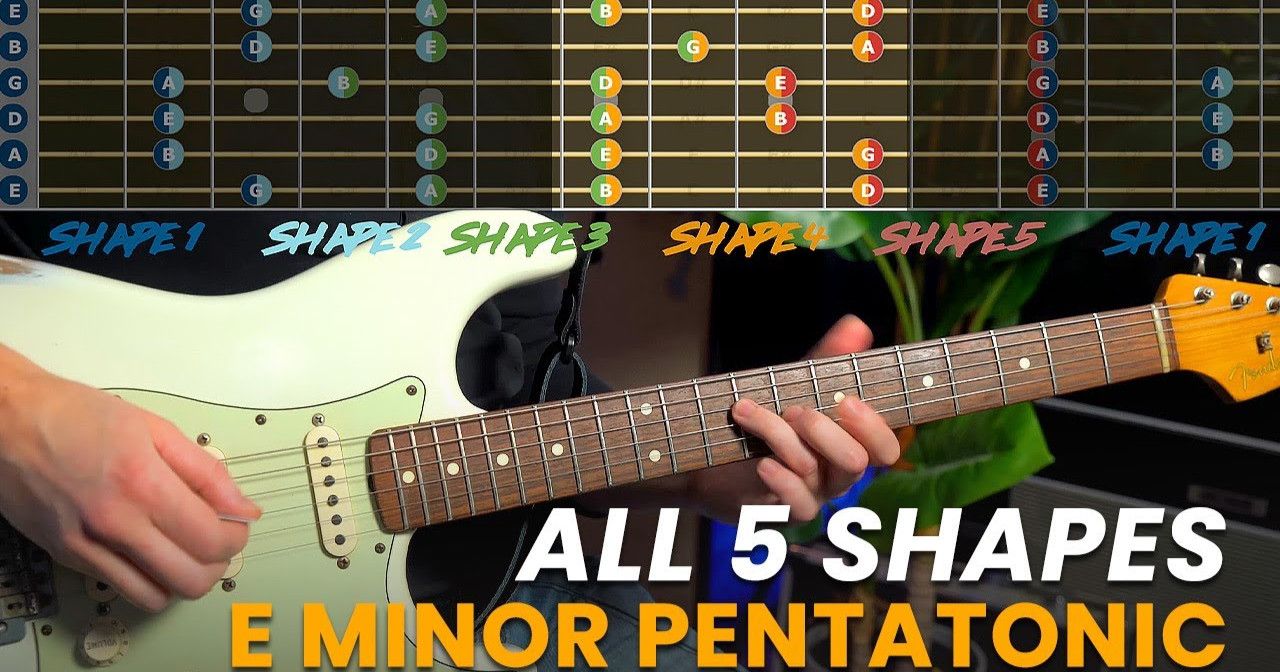
This lesson provides a complete visual and practical guide to all five shapes of the minor pentatonic scale in E minor, demonstrating how they connect across the entire fretboard and appear in countless classic rock riffs. The lesson uses a color-coded system to help visualize each shape and how they overlap.
Starting with the familiar shape one at the open position (visualizing a G chord), the lesson shows how the same notes can function as both E minor pentatonic and G major pentatonic depending on the starting note. Shape two begins at the higher frets with its recognizable top section that gets used constantly in lead playing, though the lower portion is less practical and rarely played.
Shape three is introduced as the "Hendrix shape" - immediately recognizable by its two parallel lines running straight through the pattern. This shape features prominently in Hendrix's playing style and contains that characteristic "person with arms outstretched" visual pattern. The lesson demonstrates how shape three connects seamlessly into shape four, creating what's called the "E minor pentatonic superhighway" - the section of the fretboard where Hendrix crafted most of his iconic riffs.
Shape four initially seems unusable until you recognize that an E minor barre chord sits in the middle of the pattern. Understanding this chord shape as an anchor point makes navigating this position much more intuitive. The shape constantly appears in classic rock riffs that move between the barre chord position and open strings or octave positions.
Shape five at the 12th fret is demonstrated as particularly useful, appearing in everything from Arctic Monkeys riffs to countless other modern rock songs. The lesson shows the practical three-string section where all notes sit at the same fret (5-7-5-7), making it easy to execute fast runs.
The key insight is that while all five shapes are technically learnable, shapes three, four, and five get used constantly in actual playing, while shapes one and two have specific sections that are more practical than others. The lesson emphasizes not just memorizing patterns but understanding where they appear in real riffs and solos, making the connection between technical knowledge and musical application.