Learning a FAST Guitar Solo - Easier Than You THINK? (REACTION + Tutorial)
One of the best things about playing guitar has to be finding a piece of music that excites you, feeling inspired, and then learning that piece of music. However, the exciting part can often be fast and therefore difficult to learn. So in this video, I wanted to cover how we can break down those faster guitar parts and learn them more easily. One thing that inspired me recently was a solo played by my buddy and fellow YouTuber Mike. Mike and I filmed a guitar course together a year ago, and I was listening back to those jams recently, and one of them really stuck out, really inspired me, and I wanted to learn it. With this clip you're about to watch, I came up with the riff and I told Mike to do his thing with the lead guitar line. Absolutely go for it, no holds barred, and what he played absolutely blew me away. Let's check it out now and let's see what we can learn from it. Fuzz pedal. Very tasty. we go, here's the run. Wilmart. I'm really keeping it in there, but I was like, mate, what did you just play, that was incredible. So let's see what we can learn from this. The riff that I played was using the E Blue scale. Mm. And everything that Mike was playing over the top was basically the E minor pentatonic, and we've actually gone as far as to tab it out and then sync video to that tab so you can see everything in real time. Even better, we can have fretboard visualisations as well. So let me show you what the tab looks like in this video player, so that we can analyse the bit that we want to focus on for this video. And it's up to about there cos that that run is just awesome. But it's actually a straightforward technique just done pretty quick, let's be honest, we're using demi semiquavers here, so this is some fast play. So let's slow it down a little bit to see what's happening, so let's put it at 50% speed, well. So now we're going to handle on what he's doing. This is minor pentatonic position 4. This is a position that a lot of Jimi Hendrix riffs are in, like Voodoo Child, and the double stop that starts this whole thing is very Stevie Ray Vaughan. That's the 7th fret and the 8th fret and the finished two strings. Such a cool riff, and this is why I wanted to get Mike involved in this. He just came up with this on the fly, and there's a lick every second that you want to learn and it's so cool, but here's the main focus of this lesson. Here's this run that he does next. Let's learn this. Alright, so when we slow it down, it's only when we slow it down, we, we put that back up to 100%, it just sounds like the, you know, like some mad tapping or something. Kinda looks like he's doing a lot of hammer runs as well, and that's exactly what he's doing. It doesn't, he's not picking every note, he's actually using hybrid picking which becomes really clear. When we slow it down. Look at the pick, then the middle finger. So, we've got a hammer on happening, and hybrid picking in a three-note little pattern. Starting E minor pentatonic position 3. Moving to position 4. That's 7 7 One major pentatonic, which I'll talk about in a second, but it's the same move importantly. Moving up to 12 frets, same pattern. Then finally moving all the way up to 15th and 17th round. But every time we've got these 3 notes that kind of feel the same, we're just moving positions, so we're just moving around the neck doing. This same thing every time. Hopefully you can see really clearly, I'm picking a note, hammering on a note, and then using our middle finger. To be able to play it quicker is what we talked about a little bit in the, the lesson itself. It saves the pic having to do more of the work. Such a cool run. Now when you're learning just the positions on the neck, you're often going to learn. Position 3 Position for and moving forward from there, but we don't often see how to connect them. So we need with our Mount Pentatonic runs and pentatonic licks, in the words of Paul Gilbert, we need inspiration from these players that are just have fabulous art and inspiration on the instrument. And that's this guy, that's why I got him involved for it and also because he's one of the nicest guys you'll ever meet as well. Which is just sickening, isn't it, when someone can play like that and they're nice as well. Oh, so let's have a look at this now, at 70, maybe 80% speed, what does that sound like? What a dude. Such an awesome line. Alright, I'm going for Brooke, I'm going 80%. Alright, 90, but 90's gonna be hard, especially doing it in time to the right rhythm. Again, didn't get it right. We're almost there, for demonstration purposes, we're gonna do 100%. I'm not gonna do this well because what's happening at 90% is I'm rushing the slow bit, and then I'm too slow on the faster bits. And what we need, it'd be really, I'll probably get some uh metronome work here at this point, get the BPM so we're at uh 85 BPM here, so pretty slow, so working up to that for that last few BPM to get it right. Oh, let me go for broke. I messed up already. Anyway, at least you can hopefully see the capability of this kind of interactive tab and see why we've added this to the courses and the stuff that we offer on my website and at guitar.co.uk and also on the app as well. The link to this particular lesson that me and Mike filmed, I've made available 100% free. The link is at the top of the description of this video, and you can really see, you know, how we teach this kind of jamming concept, how we're teaching next. Shapes and positions on the neck to come up with your own riffs, own improvisation, and hopefully you find it pretty inspiring. Thank you so much to Mike for getting involved in this video. Mike, I miss you buddy, let's film some videos again soon. Definitely subscribe to Mike Bradley's YouTube channel, he's absolutely fantastic. Let me know if there's any other reaction videos that you'd like me to film. This is actually my first ever reaction video of this kind, and I hope to see you in the next video, which you can watch right now.
In this video
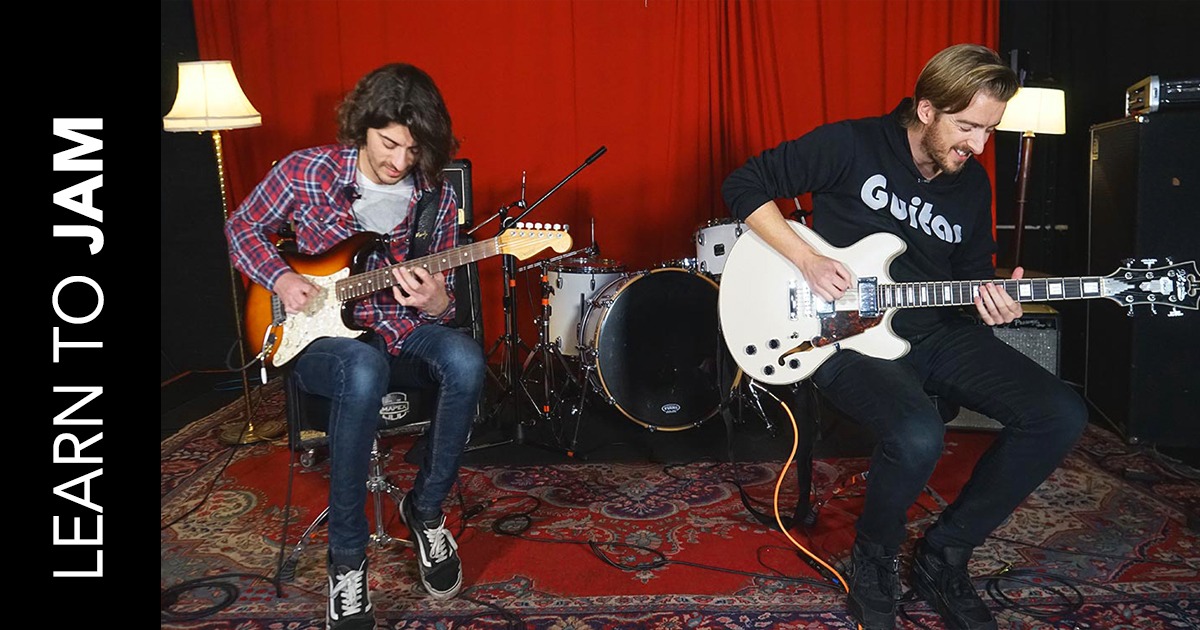
In this video I show you one of my favourite solos that I've been learning recently, which happens to be an improvised solo by my buddy Mike Bradley! The video I watch is part of this course that I filmed with Mike. Believe me when I tell you that when he played this solo - it absolutely blew me away!
In this solo, Mike mainly uses E minor pentatonic licks and super fast runs that move between positions. See a diagram below to help with learning the 5 minor pentatonic shapes, plus Mike's full improvised solo all tabbed out further down this page!
Mike's Pentatonic run
Here's the pentatonic run from Mike's improvised solo, which is the main focus of my video.

The second note of each pattern of 3 is played with a hammer on, and the last note of each pattern of 3 is plucked with the middle finger of the right hand.
E minor pentatonic scale - all 5 shapes
Each colour indicates a different shape. Notice the same shapes are repeated 12 frets up the neck, but which are an octave higher in pitch.

Blue = position 1. Light blue = position 2. Green = position 3. Orange = position 4. Red = position 5
Learn Andy's riff!
The main riff, played by Andy, is based on the E blues scale, which you can learn here

Watch the full lesson video!
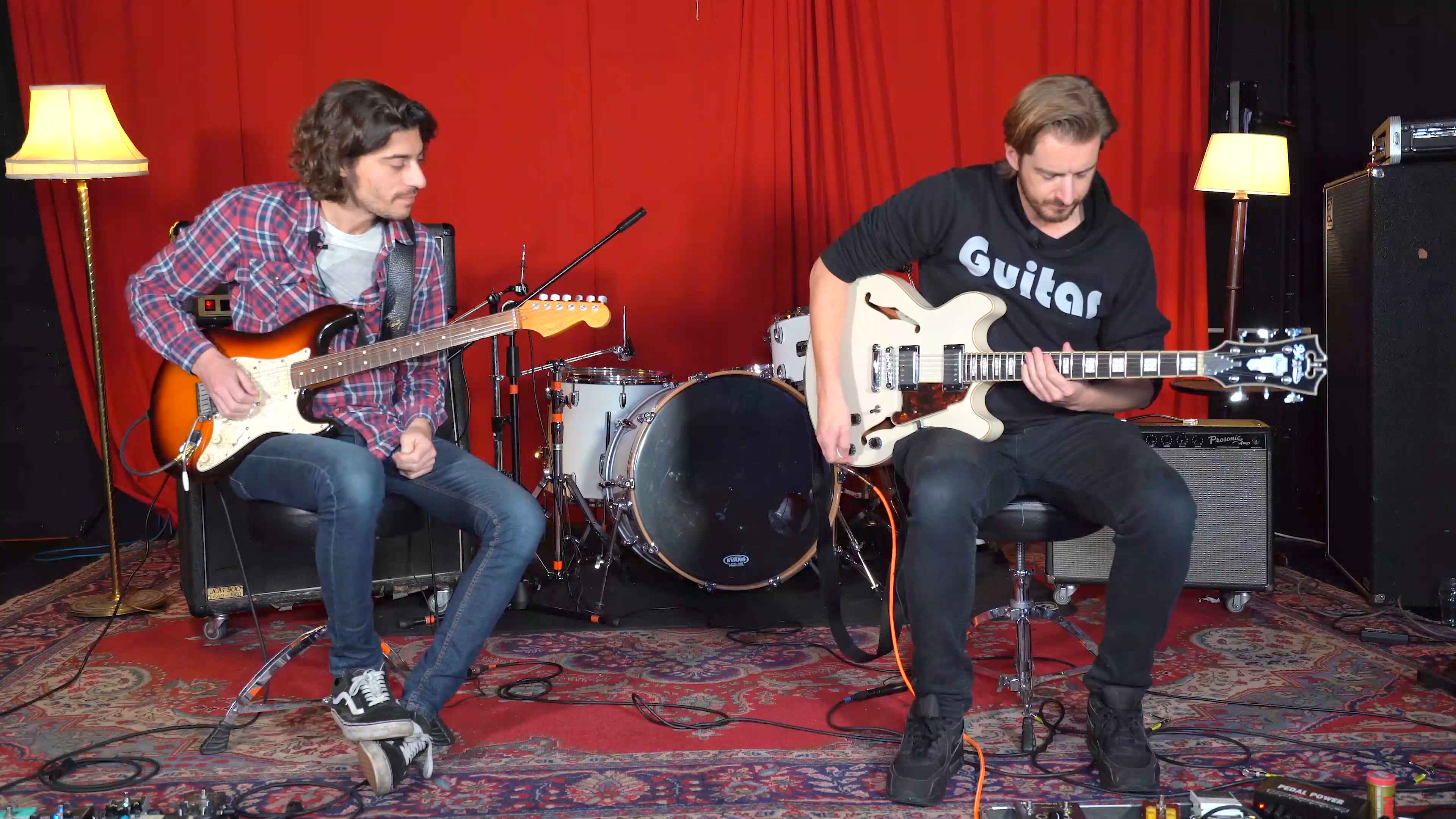
The video below is the one I was reacting to. It is from a course we filmed together 1 year ago called Mike & Andy's Jamming Masterclass where we cover all the essential of learning to jam, come up with riffs and improvise KILLER lead guitar solos like this!
What is 'Interactive TAB'?
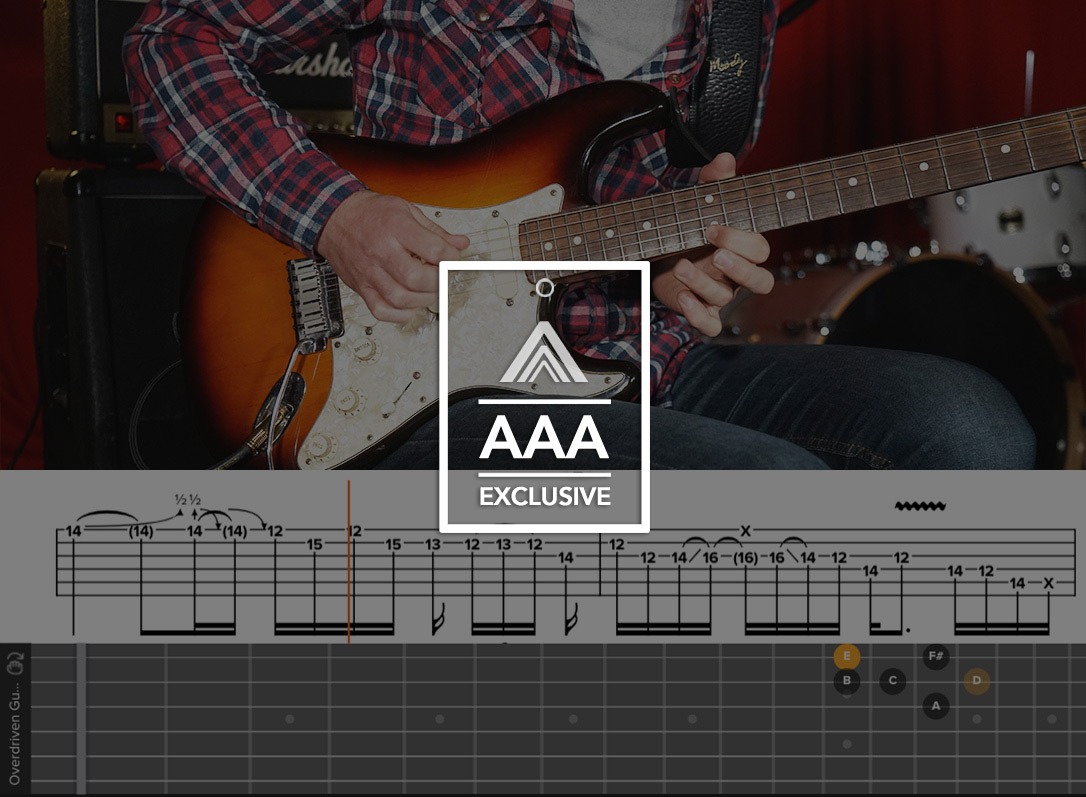
Every rhythm and lead part in Andy's premium courses is fully tabbed using interactive TAB synced to a video of that guitar part. With this feature you can see exactly what note is being played and by which finger in real time. Turn on the fretboard graphic to see what note and scale shape is being used - all in real time!
Lick too fast? You can slow down the video and tab and loop a section, then pay along and build the speed back up until you have mastered even the fastest of licks. Basically - it's the ultimate way to learn lead guitar!
>> CLICK HERE to check out the full course