
Music Theory Consolidation
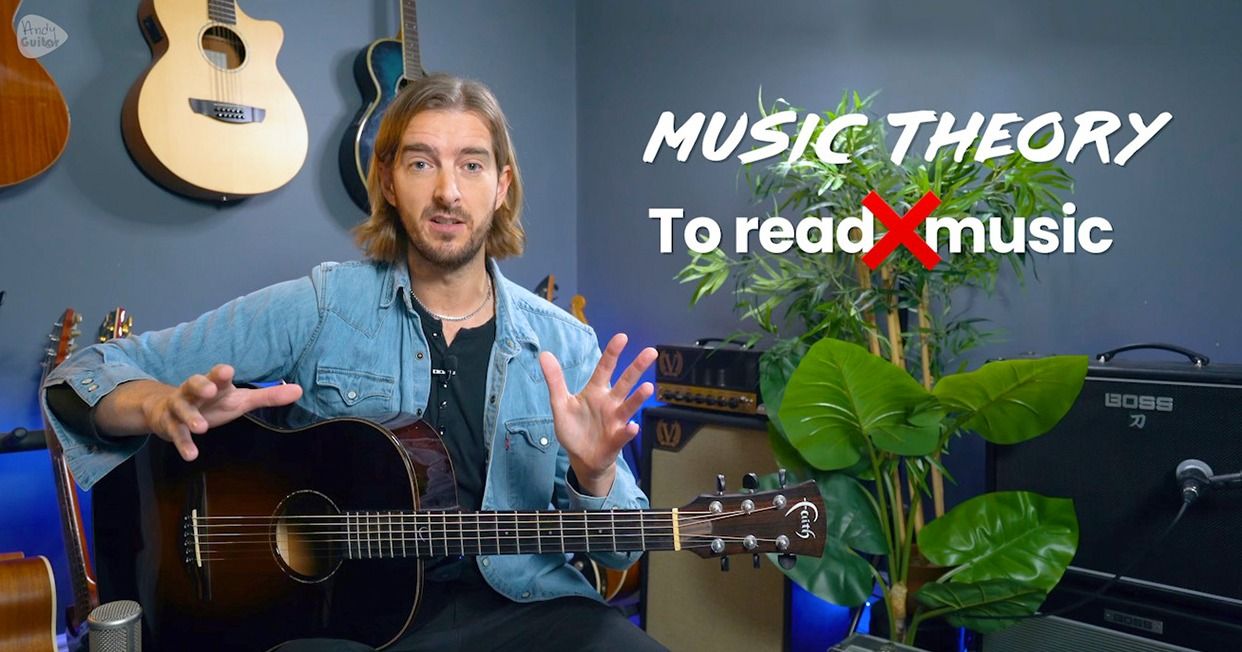
You made it, you're here, congratulations for making it this far to the final module of beginner acoustic, which as you can see, is all about consolidating our knowledge and perhaps just a refresher of some of the things we should have covered by now that should still be quite fresh in your memory and have a practical knowledge of so that we can get onto intermediate as smoothly as possible. And this first video's all about music theory. And I can understand many of you asking, hang on, music theory? We didn't cover any music theory, I don't know how to read music, and the fact is we've covered a lot of music theory in this course, but it might not be the theory that you expect. You might relate to music theory as being able to read music, for example, and that is just not a skill that most guitar players that I revere and that I. Our heroes on stage actually have, they actually can't read traditional notes on a page with a treble clef and a bass clef, or if they do, they only have a very, very basic knowledge of it, like real beginner stuff. So what is the music theory we've covered in this course and what do you need to know to move forward? Well, we need to know how to read chord diagrams first of all, and we've covered a lot of chords in this course, so I'm sure they're quite familiar to many of you now. How to read TB, we had a full video on that right at the beginning of this course, which some of you may need a refresher on cos it might have been quite a while, but that covers all the basic skills of how to read TB that you need to know as a beginner. How to read strumming patterns, and we've shown that throughout this course in their proper form with proper musical rhythm, symbols, not just the downs and ups. And finally, you need to understand the 10 terms and musical concepts that we'll be covering in the remainder of this video. So if you can do those 3. Things first of all, you can read core diagrams, you can read basic tab that we've covered so far in this course, and you can read the rhythms, then you're set up to cover the rest of the items in this module and really understand them, once we also know these 10 musical terms. First of all, nice and easy, chord progression. You should know by now that a chord progression is a sequence of chords that tends to get repeated, that might be a sequence of just 2 chords, 3 or 4 chords. For example, a typical chord progression might be C. F and G major. What we also want to be aware of is we can refer to those chord progressions also in Roman numerals, the 1, the 4, and the 5. The 1. The 4 and the 5. And when chords are written as Roman numerals or referred to as the 14 and 5, that's referring to the root notes of those chords and how they correspond with the major scale. This is referred to diatonic chords, so chords from the key or the tonic, and also the Nashville number system is how these chords. Progressions get done. And the two that you should definitely have really fresh in your mind is C, F and G are the 14, and 5 in the key of C major, and G major, C major, and D major are the 14, and 5 in the key of G. Referring to notes as numbers not only happens with chords, it happens to major scale notes and indeed any notes, and that is referring to something called intervals. An interval in all music always refers to the distance between one note and another note in pitch. How far is that distance between here and here, or here and here? And we can put a number on that, which tends to refer to the major scale or indeed any other intervals. To refer that to our 14 and 514 and 5, we have a C note which is our 1/3 fret of string 5. We have the F note directly below that, which is a perfect 4th away. And then the G note, which is a perfect 5th away from the 1st note. From the tonic. Now I've perhaps used a new word there for many of you, and that's our third term in this list, which is tonic. What does tonic mean? Tonic refers to the first note of a scale or in fact the key of a song, what's sometimes known as the hum key or hum chord. For example, 14 and 5, C, F and G. C major is the tonic, and C is the tonic of the C major chord. Being aware of a tonic helps us identify the key of a song and helps us know the name of our scales. But what are scales? Number 4, what is a scale? A scale is just a sequence of notes which varies. How many notes that is. Pentatonic is 5 notes, major and minor scales all use 7 notes. The 8th note being the octave of the tonic, the octave of the first note of that scale. And when we're practising scales, they're basically go in alphabetical order, like the ABC. We play them ascending from the tonic. To the octave of that tonic, sometimes even higher than that in one position. And we have a whole video dedicated to all the scales that you should know a little later in this module. But let's move on to the next one, key signatures. I've mentioned things like the key of C major or the key of G major or the key of E minor in this course. But what does that actually mean from a dictionary definition point of view? It actually means what are the amount of sharps or flats in that song or in that major or minor scale. Or that occur in typically in the chords that happen in that song, the diatonic chords as we call them. Now knowing key signatures is really an intermediate to advanced thing on guitar, but being aware of musical keys like the key of C major, and knowing that C major has no sharps or flats because the C major scale. C, D, E, F, G, A, B, C, there's no sharps or flats there, is the starting point. And the other keys, for example, G major, that one has one sharp when we actually look at the notes that are used, and it's this one, it's an F sharp. That might sound advanced, but just being aware of that is a huge leap forward for many people, and that will stand you in good stead for intermediate, even just being aware. That the key of C major has no sharps or flats is perfect as a beginner. Key signatures should not be confused with time signatures. Time signatures are where we have two numbers, usually 44, that dictate how many beats we have in a bar, that's the top number. And then how long those beats actually last for in time, that's the bottom number. For example, if we have 4 quarter notes, that is what 4/4 time means, like a quarter is 1/4. That just means that we're splitting a bar into 4 when we have 4/4 as a time signature, and that allows us to understand the compound time signatures that exist, even at beginner level, including 6/8 and 12/8, which both have a waltz feel or divide every main pulse into 3. They have this 3/4 time, but beginner songs on a queue. Acoustic always tend to be in 68, which we count 123456123456. Or 12/8, which gives us a little bit more flexibility feel wise than 68, and we tend to count 12, 81 and ah, 2 and a 3 and a 4 and a. But the other reason songs might be in 68 or 12/8 is when the chord progression changes. How long does each chord last for? If it typically lasts for 1 and 2 and 3 and 4 and a change chord, probably in 12/8. And if it changes every six main pulses, 123456. Chord, for example, Hallelujah, the Leonard Cohen song, and any covers by Jeff Buckley or anyone else, that chord progression changes 123456123, it changes on that main pulse of 1 every 6 notes. So that's typically known as 68. Back to chord progressions, I've mentioned something called. Diatonic chords or diatonic harmony. This is also referred to as the Nashville Number System, but this is where we name chords by Roman numerals so that we can see the chords as a function rather than just giving them an arbitrary name of C major or D major. Let me show you what I mean. That 145 chord progression. 145. Has a certain sound to it, whether we use the chords C, F, G, or indeed, if we move all that up and use the Stevie Wonder chord change, 1. 45, or if we keep going and do the Beyonce Love on Top thing, 14. it just keeps getting higher and sounds the same. The function of the chords is the same, and that's what diatonic harmony and the Nashville number systems really means, and it became known as the Nashville number systems because when people are playing all these standards. Sometimes those songs or standards aren't in a great key for the singer, and they need to move everything up or down by a tone, sometimes using a capo but sometimes using this diatonic chord theory. That is an intermediate level skill, very much so. However, being aware of what that word means is a fantastic skill to have as a late beginner before intermediate level, so all that stuff can start to make sense. Another word we've mentioned in this course is triad. We all know tri means 3. What we might not fully be aware of is even though many of our beginner chords like E major, A major, or C major, even though they're played over 6 strings or 5 strings. There's only 3 notes when it's just a basic major or minor chord. We'll cover this properly in our chords video, but just to demo this on a C major chord, cause this is where we have a triad or a tonic triad, C, E, and G. And then the other two notes of the C major chord are C and E again. And those are the notes that make up this C major chord, starting with the triad. And then Two more notes that are the same notes we've already played, but they're at a higher octave, and those first three notes, rude, 3rd, 5th, in a C major chord, is the tonic triad. If we played those 3 notes, or any notes in fact, from a chord with individual strings, we're playing something called an arpeggio. Otherwise known as a broken chord, and we can kind of see a normal chord that we strum as a frozen arpeggio or an arpeggio played all at the same time, and even if we just stagger by picking one string at a time. We've played a C major arpeggio, but what we tend to refer to is some kind of repetitive pattern with an arpeggio, so something like. Is an example of a C major arpeggio. And finally, all chords and any melodies that are harmonised use something called harmony. This is again something we've been doing since literally video one when we first learned our first chord. The first time you strummed a chord, which was perhaps E major, if you've followed my syllabus, we have harmonised this E note. With a major chord, all the notes of an E major chord that are played in open position on a guitar, however, harmonies can also refer to melodies, for example, if we play a C note. And then perhaps another guitarist, or in fact us play an E note as well, we're harmonising a C note with a major 3rd, 123, the third note of the C major scale. And with harmonies, we can actually do that. With other notes of the major scale, for example, that was the 1st, 2nd and 3rd harmonised with the 3rd, 4th and 5th, what is known as a 3rd. Harmony. There are also complex chords like 7ths or major sevenths or 9th chords like the CA 9. That use slightly more complex harmonies than just the triad chords, and hopefully, some of that made sense to you. The way to learn all this is not in one go, like I've just done here. We've actually learnt this step by step throughout this course, however, the priority, as it always should be and always. Is, is to physically be able to play the thing first. There's no point in knowing the theory if you can't physically do it. But hopefully this video gives you some ideas of where you might be a bit sketchy on some of those terms and perhaps need to go back in some lesson suggestions, which we'll link to below where the description is in this video. But also, mostly this is to set you up for an intermediate level where you have already at least come across these terms before with things we currently know, just as a refresher, so that when you hit intermediate level, you can hit the ground running. My apologies to those of you that that was just all one huge thing that you didn't get at all, but at least you know where to come back to to get some of the answers to questions you might have in the very near future. And I hope you now realise how much music theory you actually already knew, but you can actually now put some music theory terms on that, so that you can now start to ask questions going further forward that really apply to what you currently know how to play on guitar.
In this video
You might be asking...Theory, what theory? We did’t learn to read music! but we have absolutely covered and aced many music theory concepts, perhaps without even being aware of it!
Guitarists don’t need to be able to read traditional notation, treble clef and bass clef. They do need to learn to;
Read chord diagrams
Read tab
Read rhythms for tab and strumming patterns
Understand the 10 theory concepts covered below!
This lesson explains the top 10 music theory terms you should be familiar with and an explanation of what understanding you should have of them by a later beginner level, before moving on to intermediate.
Understanding these terms will deepen your comprehension of music and enhance your ability to play and create music across various styles like pop, rock, blues, folk, and country.
There are many “soft skills” that count as music theory. Pause Keef or Clapton mid way through a solo and ask them what scale their using, they might not be able to tell you. However, ask them to play a moving solo chord progression in any key, or drop them in with any other musician and ask them to just join in, and for sure they can. Those soft skills REALLY matter. But first, we do need the nuts and bolts for this to make sense.
1. Chord Progression
Definition: A series of chords played in a sequence.
Importance: Understanding common chord progressions, such as the I-IV-V (e.g., C-F-G) or ii-V-I (e.g., Dm-G-C), helps you learn songs faster and understand the structure of music.
2. Intervals
Definition: The distance between two notes, measured in half steps or whole steps.
Importance: Recognizing intervals is crucial for constructing chords, identifying melodies by ear, and developing better improvisation skills.
3. Tonic
Definition: The first note of a scale or key, often considered the “home” note.
Importance: Knowing the tonic helps in identifying the key of a song, determining chord progressions, and guiding improvisational and songwriting decisions.
4. Scale
Definition: A series of notes in a specific order that forms the foundation of a musical key (e.g., major, minor, pentatonic).
Importance: Scales are the building blocks of melodies and solos. Knowing scales helps you create more varied and interesting solos and understand song melodies.
5. Key Signature
Definition: A set of sharps or flats that indicate the key of a piece of music.
Importance: Knowing key signatures helps you identify which chords and notes are compatible in a song and aids in transposing songs to different keys.
6. Time Signature
Definition: Indicates the number of beats in each measure and which note value receives one beat (e.g., 4/4, 3/4, 6/8).
Importance: Understanding time signatures helps you maintain proper rhythm and timing when playing songs, especially when switching between different styles.
7. Diatonic
Definition: Notes or chords that belong to the same key.
Importance: Recognizing diatonic chords and notes helps in creating harmonious chord progressions and improvising within a key.
8. Triad
Definition: A basic chord structure consisting of three notes: root, third, and fifth.
Importance: Triads are the simplest form of chords and the basis for understanding more complex chords, such as seventh chords.
9. Arpeggio
Definition: The notes of a chord played in sequence rather than simultaneously.
Importance: Learning arpeggios helps improve finger dexterity, adds variety to your playing, and is essential for creating melodic lines in solos and accompaniments.
10. Harmony
Definition: The combination of different musical notes played or sung simultaneously to produce a pleasing sound.
Importance: Understanding harmony allows you to play along with other musicians, create backing parts, and enrich the overall sound of your music.
Familiarity with these terms will set a strong foundation for moving from late beginner to intermediate playing and equip you with the knowledge to expand your repertoire and understanding of music theory.
Recommended Songs
Enjoying this course? Want to test out your new skills? Find out my recommended song tutorials that accompany this course and get total access to the site by signing up today!