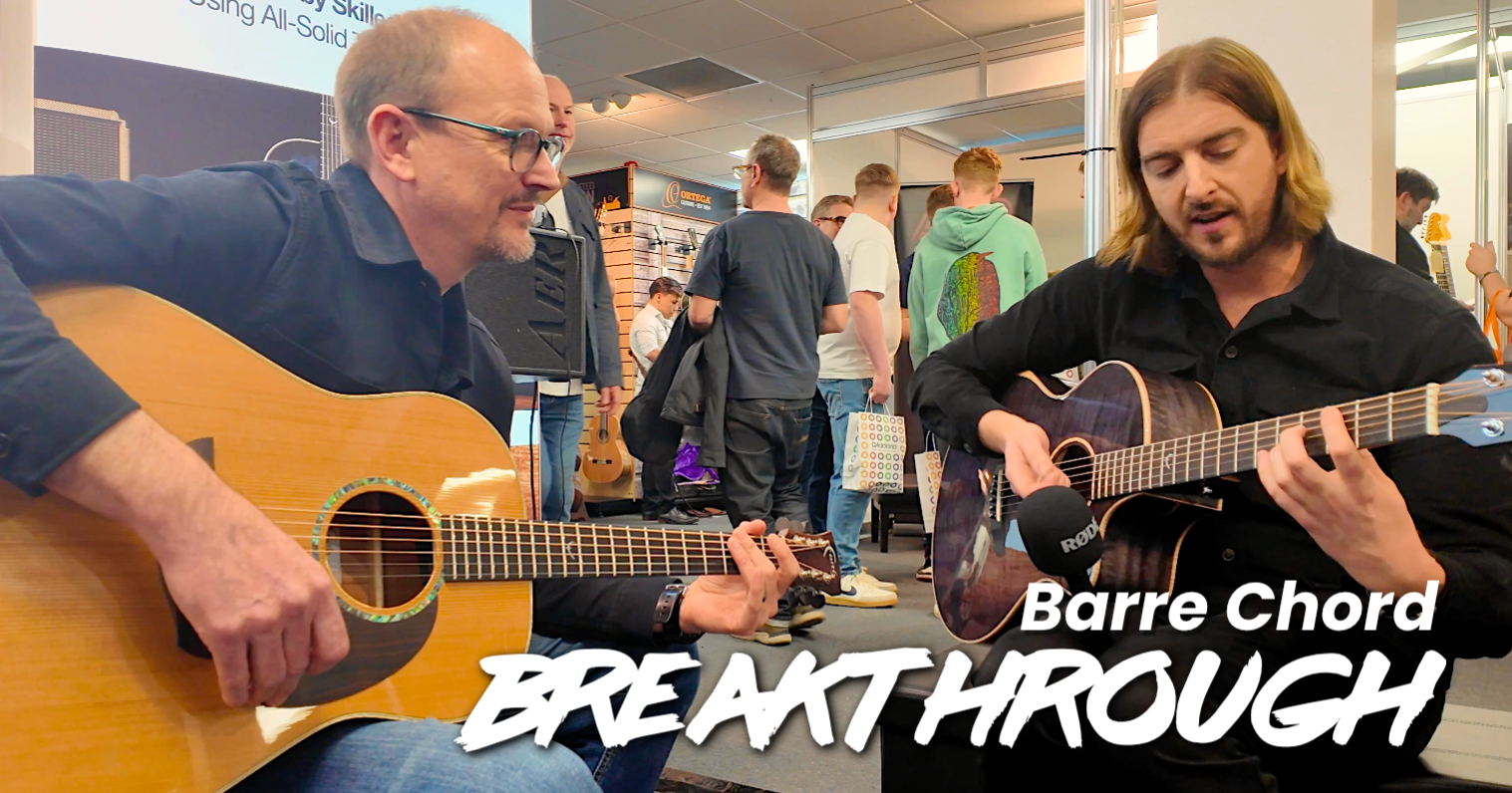
One to one lesson at the Birmingham Guitar Show
Just working at your thumb, that looks pretty good. I mean you've got the um the sofa player posture, because even though we're kind of crouched on a sofa here, look at where my guitar is. Right wedged in at the hip. Yeah. That's really important, wedge the guitar right in at your hip. If I sit down with a guitar, cos again, what I just asked you to do this, right? Yeah. I can't do that if the guitar's gonna move all over. I'm not holding the neck with this hand. Lower back. I'm just telling you what my fingerstyle teacher told me. Peter Wright in Leeds, what a guy. Um lower back support. Wedge the guitar right in at the hip, put your arm there. Still a little bit wobbly. Yeah, notice what you're having to do as well, tie your foot up. I often just put a little thing under like a guitar pedal or something under there, wedge it in. Um. That's pretty solid, have it on the top. So you're not over, we're not having to do this. On top. wedge it in at the hem, relax. That's solid now. That's solid. You don't have to support, you don't have to hold this neck as much. So now you can go 1234, and this hand's now more relaxed. Cause if I just do it again, that, how solid is that guitar now? Can I just ask you to do that, let go, let go. Have it how you were before. What's the difference? You're not in control of your guitar. That's my top tip. That was my 5 minute, 30 minute guitar lesson. What was your name, chief? It's John. John, my brother's called John. Andy. Pleasure to meet you. Thank you very much. Alright, I feel like we've got an opportunity here to have like a 5 minute 1 to 1 lesson if you would like it. Alright? Absolutely. You use the time. Well, what do you want to ask me? Um, OK, so I've been playing for probably 20 years and always really struggled with barcodes. Barcodes, yeah, and avoided them like for plague for years and years. Um, spent quite a bit of time trying to get my head around it a little bit, but just really struggled with the transition. Is there one particular song example or chord progression example? Um, I'm guessing this is like something where you would be playing like B minor, yeah, it's really hard, yep. So, you know, I can quite happily come out of B minor to something else, but to go from, there's a song that Counting Crows that I've been trying to play at the moment. Yeah, elevates the whole thing. Give us, give us the progression. So it goes, um, I don't, I've gotta think about it that, um, um. So it goes from E minor. To F minus 7. Yeah, to B minor. To G. That's a good call. OK, so what were we, E minor, F minor, B minor, so the, yeah, E minor to F minor 7. F minor, F minus 7 would be that one, so minor minor F minor, yeah. B minor minor. Yeah. So, do you know the chord after that? The G. Let's just go for those four. OK, so I. Let's take it away from that song and just go for that chord progression yeah. Just to make this not just to get that song better, right, let's make it um do the full progression better. If I was going for that. The first thing that comes to mind is I might play my F minor like that. Is that something that you're comfortable doing or ever try it? So, so, um, the, where the F would normally bar like this. Yeah. The only 3 that you need to hold down with the first finger are the thinnest 3 strings. And then the thumb's kind of over the top like this. Is that something you've ever done before? 1st 3, yes, I'm complaining like. If you're doing kind of a, yeah, but probably not a nomination. Right, here's, I'd say here's the thing, um. When you're learning barcodes, we learn them kind of like this. Right? Most of the time, if you've got a song that uses bar chords like throughout the whole thing, if it's a route 6 on acoustic, I'm gonna do that. OK. And the reason is it goes great with a C chord to it. Yeah. And a lot of people think this is a cheating app. But this is how Hendrix used to play Bartletts. And he'd often play it like this. Because this is how you can do kind of the jump for shanty. So for just to give you, I I don't, I don't want to overwhelm you with too many things, let's keep it specific, but this one, this is, this is a real um. Uh, gateway court, that it feels like you're not, you've not got yet, you've not really come across that yet. So, this will have many knock-on effects, one in particular is lead playing. But do you only play acoustic or do you play electric as well? Uh, predominantly acoustic. Acoustic. So this crops up more on electric. Yeah, but it works great on a few, especially these faith nets. So and what this comes back to is the one finger chord. Do you ever do that? Yes. Play, play that for me. It's basically that, you see how your thumb is here? Yeah. Keep it like that when you're doing this F minor. Just try and mute string six. Yes, that's it. And then have this first finger totally flat, so we're doing that F minor thing, but just get that first of all. Yeah. So it'd be perfect, but you're gonna need to wrap your index, so relax for me. Um, keep still but relax while you're doing this, cos you wanna wrap that first finger around the back of the neck, aye? And I mean wrap it all the, yes. As a hint, that's how you play lead guitar most of the time, or, or, or what all the blues guys do. It's also how we do that chord, not, not like that. Wrap it all the way round. Do that, and have your thumb if you can how it was before, just that one finger chord. Yeah. That's to that. And that's the, that's the technique. Not quite that, you can literally, with this, you can palm right on the back of the guitar, which is why it's really comfortable. So there's, there's no, no, often bar pas this right, and it's a lot of fun between that, all that's gone with this. So one example is C2F. That one. Why would you go for that over the full bar so you can embellish it, if you do all the. I can do all the same embellishments here. And even while you do the Hendrix one, which is this, where we have that thumb even higher over a mute A. I can play a C major scale. But I can't do that with a bar F. And that's why to conquer bar chords you don't need to always bar 63. That's not the trick to mastering bar chords. It's often that thumb over the top. So that's what I call it the F hybrid because it's kind of a hybrid between like this F which is a more beginner one, and the full barcod. Yeah, it's a bit of both. Well, it's great for an F minor. Which can be very hard to do like this, but I'm often doing it, but it's the wrist. Look at how the wrist goes to there when I'm doing it, as opposed to that. Um, so that, that's all root six chords. When I see um uh Arctic Monkeys, Alex Turner playing his stuff on acoustic. Yes. He'll always do that. Why? So he can rest his hands more come. And if he wants to do an embellishment or do he'll lead cos he's an electric wire. This is how we actually play lead as well, like that. Not like that, this is finally how we practise the scale. Yeah. But often I'm over the top. Thumb over the top, thumb over the top. So all your route six bar chords, F, F minor, G, G sharp, all of that, major or minor, try them for a bit with thumb over the top, OK, and acquire that skill. Yeah. Cause it really helps all these fingers, but it, it'll ring out. For B minor, uh, two options. Just, just suck it up and get it, practise and practise. Is one. Second option, uh, basically a B7 in and out of the first finger. Is a B minor setup, and that works D, A, B minor, or what the chord progression we had before. myself That one would work too. What I often do and a lot of people do is play a power chord and old. I have it ringing now, but that might be not as much for the minor. I saw you do like this before, that was good. I think the one warm up exercise that would probably bring on your play more than anything, um, is literally doing what I call X's up the fretboard. The first time you do this, this is gonna feel so odd. But it's actually so simple and really prepares you for a lot of this, a lot of this, any of that. Basically, where wherever you want to go, do it on the middle four strings. Like say fret 55678, and then 568 the other way. Yep, yep. I call it X's up the frettle. The first thing I do when I pick up acoustic or electric is typically that. And you won't get up to that speed, but after a week of doing that. 1 minute a day, 5 minutes a day, and then play, you tell me the difference. I can't. And it just allows you to see what you've got, because again when you're, I'm looking for things that are gonna make everything easier. This one forward, if you get that, it's, it's a good thing, it's a gateway, but it only really helps other minor chords like that. Yeah, a little bit of crossover to play. That one, even if it takes flipping ages to get it right. Even better, like hover over and then put it down, hover over and put it down. Like that. I like that. You can even do that while, while the telly's a ha, yeah. And just try and make that, and you can do it on the thinnest 4 strings, the fattest 4 strings. But you're about, I mean all the stuff you're asking about barf boards and the strumming that they, it's intermediate level, it's not a beginner, it is intermediate stuff. If I was to give you one intermediate warm-up to improve your hands, don't even hold your picking hand, that's it. And it's one line the other way, one line the other way. Try it, try it once, see, just to see what we're working with. So try about rep 5123, and then 4. Yeah, this is where I, this is where I struggle here. Yeah, with the, with the persevere with it, yeah. So you can do it. It took you a moment, but you can do it. What I would do there is relax your fingers but keep them still. Keep everything still. How that feels, get really comfortable with it. Keep them there but relax don't even hold it down to the fretboard. To play intermediate level, you need to be really relaxed in your fingers and not have any more pressure. Um, have a look where that is, I'm just looking at where it says, that, that looks good. OK, look at that, try and visually memorise it. Yeah. Take your fingers away by about 1 centimetre. And then put them back down. Yeah, same again, centimetre. Back down. Yeah, centimetre, back down. OK, relax, shake it out. Cause it's a whole thing, that was new, right? Yeah, yeah. But look at, look at now that B minor bar chord, whichever way you're doing it, what are these fingers doing? The B major bar chord, what are they doing? They're often not bar, they're either this way or that way. Yeah, sure, yeah. So, the other way. Was this? 1234. You were like this before, so you were like this way. Do it this way. So uh index here. Yeah. Middle, 3, 4's gonna be there. Now this is the tester, but that's as far as you have to stretch. Now, I'm just working at your thumb, that looks pretty good. I mean you've got the um. The sofa player posture, because even though we're kind of crouched on a sofa here, look at where my guitar is. Right wedged in at the hip. Yeah. That's really important, wedge the guitar right in at your hip. I know the phone's in stock, yeah, yeah, it's a whole thing. But if I sit down with a guitar, cos again what I just asked you to do this, right? Yeah. I can't do that if the guitar's gonna move all over. I'm not holding the neck with this hand. Lower back. I'm just telling you what my fingerstyle teacher told me. Peter Wright in Leeds, what a guy. Um lower back support. Wedge the guitar right in at the hip, put your arm there. Still a little bit wobbly. Yeah, notice what you're having to do as well, tie your foot up. I often just put a little thing under like a guitar pedal or something under there, wedge it in. Um. That's pretty solid, have it on the top. So you're not over, we're not having to do this. Yeah. On top, wedge it in the hymn, relax. That's solid now. That's solid. You don't have to support, you don't have to hold this neck as much. So now you can go 1234, and this hand's now more relaxed. Cause if I just do it again, that, how solid is that guitar now? Can I just ask you to do that, let go, let go. Have it how you were before. What's the difference? You're not in control of your guitar. They're actually wedged in at the hip. I'm, I'm on top of it, not over it. I'm on top. Inside of the elbow there. So I had to learn this finger style. Cause I can't play finger style if I'm having to hold the guitar like this and having to support it with the nap. Solid as a rock. And you're relaxed. You could hold that all day. Yep. Key with that is arm on top. No, not over there, don't, don't try and hold it with it, just rest it on top. Yeah. Solid as a rock, man. So that all your bar forwards will get easier now, but the one test, 1234, do it one more time with this guitar really solid, that looks great. I mean a bits up there, that's it. That looks good. But yeah, you would do really well with some sort, you can go, I'd I'd honestly just stick a guitar pedal under your heel. Yeah. Or something that would, you can get a footrest. I've got a footrest. Uh, I honestly prefer just raising the heel a little bit. Go for it the other way as well, can you remember? So index here, 1234. And this gets about there. So it's level, right? Otherwise you're you're making like you're you're gonna end up on the, and it's the couch thing. Corner of the couch, you can't sit back on the couch. Uh, that looks really good. Is this, relax your finger, every time you're doing, if you're not playing. So every time I tell you to relax your fingers, you're taking your fingers away. Relax but keep them still. That's literally the trick. When we're practising new chord shapes, watch me again, just touch the strings. Don't squeeze it down to unless you're picking it. Because what bit are we really trying to get? Again, you're holding your fingers there now and they're real, and they're really improving, but if you're holding tension in it, it it's gonna take longer to actually hold you back. Cause when I'm doing this, I'm like tensing it for a millisecond, but then I'll let it go. Well it's interesting. Look at how that guy over there who's actually strumming, look at how he's holding his guitar. He's got his knee up, and it's right into his body, the guy that sat down. It's honestly a real thing, otherwise you can't relax. If it's that, if it's anyway wobbly wobbly, you'll have to hold it and you'll have to tense. That's my top tip. That was my 5 minute, 30 minute guitar lesson. What was your name, Chief? It's John. John, my brother's called John. Andy, pleasure to meet you. Thank you very much.
In this video
I gave an impromptu 1-to-1 lesson at the UK Guitar Show with John who'd been playing 20 years but always struggled with barre chords and avoided them. We worked through a Counting Crows song progression and it revealed the real issues and solutions.
The barre chord breakthrough: I showed him that most people learn bar chords the hard way - full six-string bars. For root-six chords (F, F minor, G, etc.), I use thumb-over-top technique instead. Bar only the thinnest three strings with your first finger, thumb mutes the sixth string from over the top. This is how Hendrix played F chords, how Alex Turner plays Arctic Monkeys acoustic parts, and crucially, how you play lead guitar.
Why thumb-over-top matters: The full bar chord locks your wrist in an uncomfortable position. I explained that thumb over the top lets you rest your palm on the back of the neck, keeps your wrist relaxed, and frees up fingers for embellishments. I can play the entire C major scale while holding an F chord this way - impossible with a full bar. This technique is the gateway to lead playing and how all the blues players do it.
The F hybrid: I showed him there's a hybrid between the beginner three-string F and the full Berkeley bar that's perfect for F minor (which is very hard to bar fully). It's about wrist position - I demonstrated how the wrist angle changes from the full bar to the hybrid.
B minor solutions: I gave him two options - either practice the full bar until you get it, or use B minor sus (basically B7 without the first finger). Also works as a power chord. For the Counting Crows progression, B minor sus fits perfectly.
The warm-up that fixes everything: I recommended "X's up the fretboard" on the middle four strings. Frets 5-5-6-7-8, then 5-6-8 back the other way. It's the first thing I do when I pick up acoustic or electric. Feels odd the first time but prepares you for all these chord shapes. Do this one minute a day before playing - it's a gateway exercise that makes everything easier.
Guitar positioning is critical: I had to correct his positioning - wedge the guitar right into your hip, not in front of it. Lower back support, arm resting on top of the guitar (not reaching over it). This is what my fingerstyle teacher Peter told me. If the guitar is wobbly, you can't relax - you're constantly supporting it with your fretting hand. I told him to raise his heel slightly (stick a guitar pedal under it) to get the angle right.
The relaxation principle: I showed him that intermediate playing requires relaxed fingers with no excess pressure. Practice holding chord shapes without pressing down to the fretboard. Keep fingers still but relaxed. Lift them a centimeter and put them back down to build muscle memory. You're tensing for a millisecond when you play, then letting go - not holding constant tension.
Visual check: I pointed out how other players hold their guitars when sitting - the guy strumming across the room has his knee up, guitar wedged right into his body. That's the position. You can't relax if it's wobbly anywhere.
The breakthrough wasn't about practicing bar chords harder - it was about learning the proper technique (thumb over top), proper guitar positioning (wedged at hip), and proper tension (relaxed fingers). Twenty years of struggle solved in one spontaneous lesson at a guitar show. That's my top tip - that was my five minute lesson that turned into 30 minutes.
The song John referenced was Counting Crows - Elevator Boots free chord sheet here