
Day 10 - Gimme Shelter - In Open E
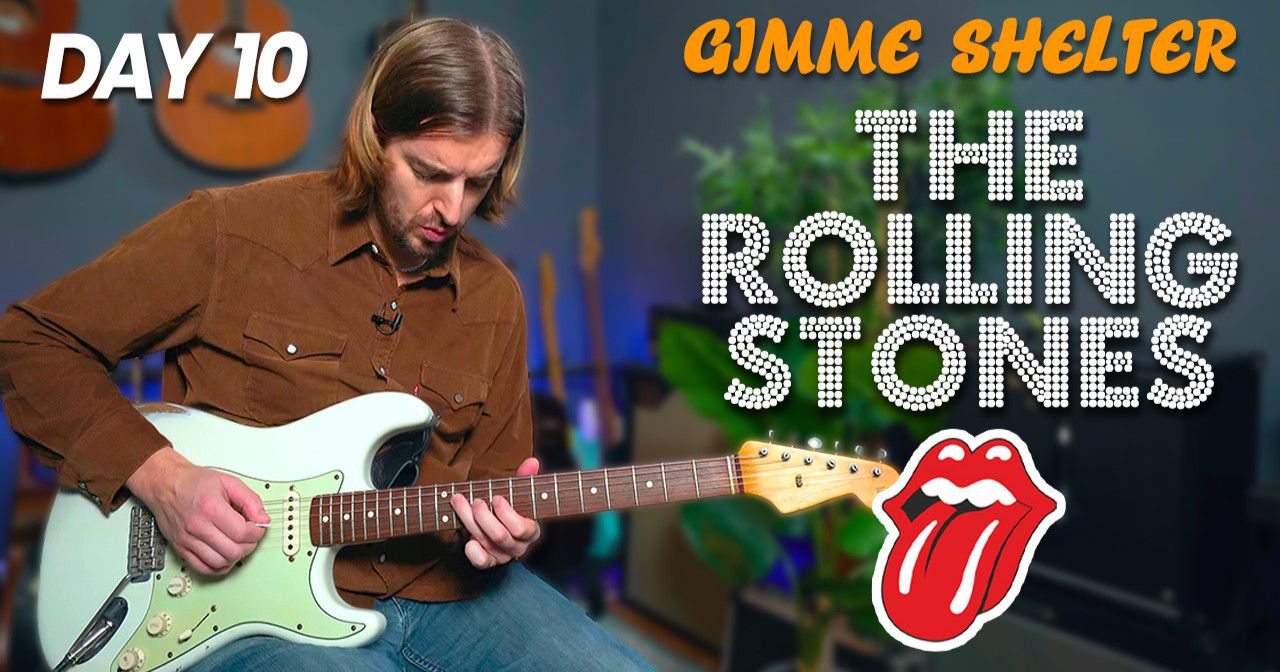
Alright, give me shelter. This is an open e-tuning to be able to play this signature uh riff. There's some lead lines to this one, but those are in standard tuning, uh, quite minor pentatonic bass, to be honest with you. But of course this song is all about this classic riff. Um, I have effects on my guitar, so I have some reverb. And I've changed to this D'Angelio XL Mini DC. Uh, bit of a mouthful, but that's what this guitar is called. It's based on an ES, which stands for Electric Spanish, um, type, which is what, uh, Keith uses when he plays this live. And it gives it more of that swampy tone, especially just on basically a clean setting. But not a jangly clean setting, it's very, you know, the humbuckers and the. Pollen, body, everything's just up to vertical there on the amplifier. But that makes it with the reverb. And very dynamic as well, if I pick light. It cleans up And if I go for it, you've um plenty of low end for sure. The added effect is a tremolo. All that's doing is swapping the um it's putting an oscillation on the volume, so it's wah wah wah wah wah wah wah, it's doing that effect but it's purely volume wise it's going on. Kind of a um sound wave that you can clip however you want, and that is what. That is basically what we're playing there. So these three chords are basically a C major, B major. And A. So this is E, A and B just to navigate our e-tuning a little bit. So we're always just staying to those dots basically. And like we learned in Open G tuning. The standard Keith Richards shape here rather than being here is one string up. And the signature intro of this song and many of the licks actually use this chord. With the middle and 3rd finger on adjacent strings on the middle two strings, same two here on the B. So C. And then when it goes to the A. It goes um it uses a mode basically but just to simplify it, it goes to the 7th fret and 5th fret. Flat 1st finger at the 7th fret, middle two strings, 3 and 4 with the 3rd and little finger. And these always work together. And then we're back to So that's a nice starting point before we get into the picking. Now let's combine that with a bit of the picking. So I'm following the Guitar Pro 8 tab for this, um, the My Songbook tab, it's pretty fantastic as I've told you throughout this series, but we're gonna start off. With those three strings, 54, and 3. And then before we pick 3, we put down the middle finger and 3rd finger together. That's the move That's basically the move we need to get down. Now for this first, it's the same-ish move for the first two chords. But for this 1st 1, it's 2 strums just with the middle finger down and 1, 3rd comes off. Same for this next one, but it's only one. No it was only the last one that the 3rd came off of, so. That's those first two chords. Next we're doing kind of a round of 3, this gives it a bit of a polyrhythm feel. So that's 1 and 23. And then Whole thing really slow without the effect. 234. Next, embellishment, but remember all of these are very free flowing. Try and get the first one right after then vary intentionally cos that's what's done on the recording. So that is. And that is the 5th, 4th, and 3rd of a major scale. And that is intervals if you've not come across that yet to learn that kind of way of playing, that's intervals. The final part is always the same. And now let's do it with the effect. 123, tremolo. Then we go just to straight chords. And this is basically the chorus part. Let's learn that, so this is 9, which you can support with your middle finger, hold these two together. Open 55, open 7, open 7. Down, down, down, down, down. Then do not overlook. The verses. Even though they just stay on the C major chord, 9th fret bar, but we've got. This little minor thing happening. It's a bit minor pentatonic-y, which we'll do with the little finger, flat little fingered at 12 and 12 on the middle two strings. And then the Keith Richards chord. And then a little Little finger goes down, just at string 5, fret 12, 234. to Let me stick some of that into my looper pedals, so let's go from the um little riff, 234. It's in the looper, right, let me grab my standard tuning guitar and let's look at how to play over this. All right. So what stuff are we using there? All minor scale, not minor pentatonic, actually full minor scale, but let's think about minor pentatonic. This is at the 9th fret, shape 1. You could do a real one. It's just a shot away. It's just a shadow. You could think about it like that, and that's also where you're. That little lead line is, I've got a little boost pedal on this, same sound as before, just with the chaffer replica. Just to boost it a bit, that's your standard bends in your minor pentatonic. But then to do. The main melody. We're adding in one note here which is the 2nd, so root. Major 2nd, minor 3rd. storm is threatening. children Just a shot away. It's just a So try and find that melody, it's really cool, as I've said time and time again, to try and find the vocal melody, cos it gives you a lot of the licks. That you might want to use in your solos. And if you wanted to play the rest of the song. Kind of put that in your looper pedal, you could do just with basic bar chords, 1234. Oh yeah, and that is the last video of the 10 days, but don't worry, there is more, there's an extra 5 days coming in the premium version of this course where we're gonna look at, now we've learnt the riffs, how can we use this in our regular playing, using songs as examples, but taking this forward to basically be able to play any song in open G, open E, and be able to. This ancient art of weaving with rhythm and lead, free flowing and not over relying on things like tab, cos we really know our guitar neck inside out, we know the keys, and we know the tricks of the Rolling Stones. I really hope to see you over there guys, there will be links and information in the description below. I'll see you in the next video. Thank you for joining me, bye bye.
In this video
Gimme Shelter's signature riff requires open E tuning and benefits from a tremolo effect, creating that haunting, swampy atmosphere the song is famous for.
What You Will Learn:
How to tune to open E (E-B-E-G#-B-E)
The 3-chord riff: C#m, B, and A with signature voicings
The picking pattern using arpeggiated notes with chord embellishments
How the tremolo effect creates that haunting, swampy tone
Standard tuning solo using C# minor scale
Open E Tuning
Open E means strumming all six strings produces an E major chord. Tuning wise - Strings 6, 2, and 1 stay the same
Then, string 5 (A) goes up to B, string 4 (D) goes up to E, string 3 (G) goes up to G#.
The Signature Riff
The 3 chords (C#m at fret 9, B at fret 7, A at fret 5 – use your dots!)) use the Keith Richards shape moved up one string from Open G position. So, the index finger continues to barre, but the other fretted notes and shape is moved up a string
For the intro riff picking hit strings 5 then 4, then add middle and ring fingers before picking string 3. This creates that distinctive arpeggio-into-chord sound.
The Tremolo Effect
The tremolo pedal oscillates the volume, creating a wave-like effect. Combined with reverb and a semi-hollow body guitar (Keith uses an ES-style), this produces the song's haunting atmosphere. The dynamics are crucial – picking lightly cleans up the sound, digging (playing harder) in adds grit.
Standard Tuning Lead
The lead melody uses C# minor scale (not just pentatonic) – root, major 2nd, minor 3rd. Finding the vocal melody is a great way to develop solo idea!
10 Day Rolling Stones Guitar
Recommended Songs
Enjoying this course? Want to test out your new skills? Find out my recommended song tutorials that accompany this course and get total access to the site by signing up today!