
8th All Down Strumming
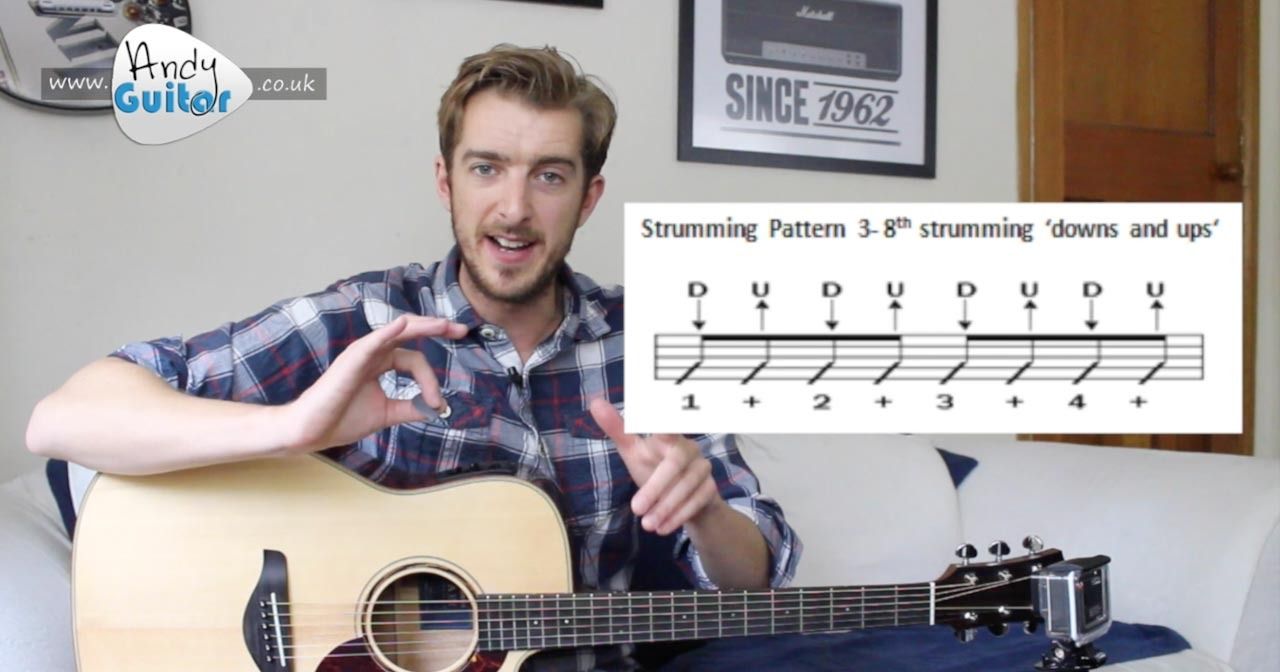
Hi guys, this is strumming pattern number 2 in my strumming guitar course, and this is the easiest, more complex strumming pattern, so the first more complex strumming pattern to try after going for 4 on 4 down strums on the beat. The song example of this in my beginner's course would either be chasing cars from level 2 or from level 1 silence Is Easy also uses this strumming pattern. So after this lesson getting straight on to try those songs is gonna give you maximum benefit of doing this cause you've got that real life example. But what's happening here is we're essentially playing twice as many down strums, twice as fast as 4 on on the beat. So twice as fast as 1234, and twice as many, but we have to importantly do this to a count of 1 and 2 and 3 and 4 and. We can't do it 12345678 because the we have to know where fundamentally where the beat is to know the tempo of a song. So the tempo of the song, otherwise known as the BPM or beats per minute is how fast or slow the pulse of the song is, and the pulse of that song is the beat. So here's the kind of tricky thing, more strumming can often mean that a song is actually slower. And this strumming pattern, as it says on your beat is better for slower tempos. As this idea of slower tempos, 74 BPM to 110 BPM gives you a ballpark figure, though later on we might be increasing those as you get better. But as I say, the speed wise, silence is easy and chasing cars and also common people from level two gives you that idea 1 and 2 and 3 and 4 and 1 and 2 and 3 and 4. And we're gonna be hitting all of those with all downs. Ideally you'll be going for this at level 2 of my beginner's course for which we're gonna be playing the A major chord and we're gonna play in the fashion that I have taught you in the chord lessons. So uh let's go for just one bar of this 8th all down strumming pattern to a count of 1 and 2 and 3 and 4 and. In 2341 and 2 and 3. And stop there. Let's go for that one more time for those of you that missed it. In 2341 and 2 and 3. And stop. So we have to let fly a little bit but we wanna be doing all the correct hand motions which are pivoting from the elbow, keeping the wrist in close but still, and trying to catch all the strings as evenly as possible and to an even tempo, making sure that all your strums are even. Let's go for this for 2 bars now, exactly the same as we as we just did, but for 2 bars. In 1. 2341 and 2 and 3, and again. 3 and 4 And stop. So that 2 bars is 2 counts of 4 for which we've done this strumming pattern, which is crucial that in your mind you can start to automatically count this beat, so you count where the pulses are, but we will be strumming a lot more than that, so it needs to be. internalised. A great way to internalise that is by tapping your left foot if you're a right-handed player, because that sends the signals from your mind down to your feet, not only to your hands, but that really makes this strumming rhythm internalised. Um, let's go finally for 4 bars of this A chord, and that will nail our strumming pattern for a. And that will nail strumming pattern number 2 from this course. So we're gonna go for 4 bars of the A 8th strumming in 2341 and 2. 2. And And stop there. Let's try and do that without my counting now, exactly the same, just without the count. Play along in 234. And stop there, that's our 4 bars. It's really crucial that there is no emphasis more or less on any one of those strums. They all need to be of an even volume. It's a higher level skill to put emphasis on certain. Ones and to miss certain strings and hit some strings at a certain time, and that's something that we don't want at this level cos it needs to be controlled, and there are certain ways of doing those emphasis, that would be further down this strand of um this, This strand from the sheet that we've gone for before, so when we're going down. So if you choose, you can now skip to strumming pattern number 5, eights all downs with accents and start to learn how to strum some louder because that's appropriate for this strumming pattern. Because that's essentially going to be the next level up from this strumming pattern. But if you're still unsure and you're new to this and you've not done a song yet, I definitely recommend to do. A song with this strumming pattern, which if you stick to my beginner's course is gonna involve changing from the A chord to the D chord and keeping this strumming pattern going. So if you're a beginner, that's the first point of call, learn a song, silence is easy, chasing cars or common people with this ape strumming pattern, which we generally use the change from an A chord to a D chord. But if you've been playing guitar and you've learned quite a few songs and you're a bit more experienced, you can get straight onto strumming pattern number 5 and start to put accents in this strumming pattern and that's gonna sound really great. So join me for that lesson and I will see you over there real soon.
In this video
Andy Guitar Strumming Course Ebook 2nd edition
8th notes- splitting a bar into 8
This is how a single 8th note looks alone. This is not seen often seen in the early stages but stay with me…

This is a pair of 8th strums. These add up to 1 beat and are joined at the top- the idea is it makes it easier to read.

If we do this for every strum in a bar, we split a bar into 8 strums, hence the name ‘8th strumming.
Strumming Pattern 2 - 8th Strumming
Here, you simply play twice as many twice as fast. However, the count MUST be ’1 + 2 + 3 + 4 +’ otherwise your chords will be to the wrong count.

Interactive TAB
Set tempo to 80bpm (start slower if you need to), hit 'Loop', and jam along!
On mobile, double tap TAB to loop and click the 'cog' symbol to set bpm.
Interactive Tab
Become a member to access this interactive tab section.
It really helps if you develop the habit of tapping your foot whenever you listen to any music. This will help you feel a beat naturally, rather than having to count it. You should also work towards tapping your foot on the beat with ALL strumming patterns you learn. This means you will internalise the rhythm and make playing in time natural and easy! Tap your foot on the beat while playing either of the strumming patterns at this level, or any that you know. This is particularly beneficial along to a metronome or drumbeat or by playing along to the song itself.