
8th Strumming with Down and Ups
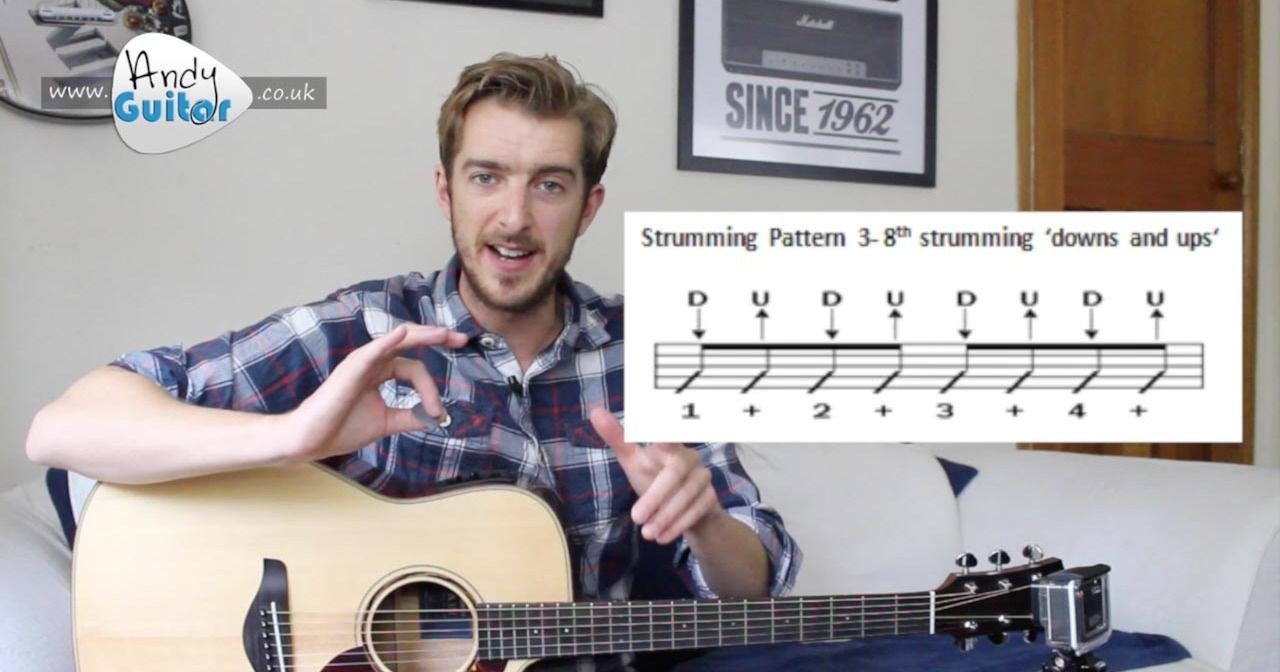
Hi guys, this is how to play strumming pattern number 3 from my um strumming beginner's course. Now this strumming pattern is appropriate for faster tempoed songs. Number 2 is appropriate for slower tempoed songs. And when a song is either fast or slow, there are certain higher level. Level strumming patterns that inevitably use one of those strumming motions. So we'll be talking about that a little later, but knowing that this is for faster tempoed songs is so crucial, even at this early stage, if this is one of the is one of the first proper strumming patterns you've ever gone for. And it's to the same count as the previous one, so 1 and 2 and 3 and 4. What we call an 8th grid because we've split a bar into 8. But we can't count to 8, we've got to count 1 and 2 and so that we know where the beat is and so that you know where to tap your foot. So you tap your foot on the beat, right? Um, this is appropriate around level 2 or level 3 of my course, so we're of the beginner's course. So we're gonna be going for a D major chord. In the demonstration. And we need our hand motion now to be down and up. So we're gonna be adding some up strums because a down up motion is more economical, meaning we can do it faster. So I can do down up. A lot faster than I can go. Down, down, down, down, down, down, down, down, down. OK? So I need to get used to this down and up motion at a steady pace, first of all and then speed it up because it has to be even, otherwise we, if we haven't got our strumming patterns even at this point, we haven't got any foundation. So a demo of one bar of this strumming pattern will be. That's one bar of the de chord. Um, the tricky thing with the decode is we want to now try and miss out the thicker couple of strings. If that's really tricky for you, you can go back to doing it with the Echord where you can hit all. 6 strings nice and even, so that would be. Again, 1 and 2 and 3 and 4 and. But for the remainder of this video, I want us to have a go at trying it for the D chord so that you can try this in real songs and the real songs that this is appropriate for are ideally Johnny B. Goode and Hound Dog from level 2. but you also have the option of Songbird and Mr. Tambourine Man from level 3 if you've done some level 3 songs from, uh, the Beginner's course. That beginner's course is available online for free at Andyguitar.co.uk. So let's have a go at playing strumming pattern number 3. Together we're going 8 strumming, all downs and ups, so 1 and 2 and 3 and 4 and for 1 bar, 2 bars, and then 4 bars. Let's have a go. In 2341. 34, and stop. Let's have a couple of goes at this one now cos I know it is trickier to miss out this thicker string. We wanna make sure the angle of your hand. Is slightly across the strings like this. So that we miss out the thicker couple of strings, but with the decord you can keep your thumb on top if you so wish to mute that thickest string. And take it out. One bar of D one more time in 2341. And stop there. Let's go straight away for 2 bars of D, so twice as many in 2 and 3 and 4 and 12. And again. can stop. So there we have 2 bars of our decode which is written like this. We can see that down and up motion. And then finally, the acid test is can we do it for 4 bars. So we're gonna be counting to 44 times and keeping this strumming pattern going, keeping those downs and ups even, swinging from your elbow, keeping your wrist in and trying not to catch that thickest Estring. In 2. 341. that. Let's go for that a little bit faster causes this strumming pattern is appropriate for the faster songs and momentum starts to get you to do it better, get everything sounding a little bit better. So let's go for this, still on the Dchord, staying on the D-chord for 4 bars in 2 and 3 and 4 and. Little bit faster again, same thing in 234. So that's something you definitely want to have a go at in your own time and as soon as you can get straight onto the songs. So this is Johnny B. Goode, Hound Dog, Songbird, or Mr. Tambourine Man from levels 2 and 3 of the free beginners course, um, songs wise. And you can then get straight on to strumming pattern number 6 if you wish to carry on with this faster motion where we'll be taking out some of those up strungs. But if you're staying strict with. This course and you're not fast tracking, you're doing everyone in turn. I will see you in strumming pattern at number 4, where we're gonna be going for some reggae offbeat strumming. Now this is also used in classic rock and acoustic music, pop music as well. It's not just strict to reggae, but it does make you sound a little bit reggae when you do it. So, so I'll see you in that lesson and I hope you're enjoying the course so far. I hope you're getting the fundamentals of your strumming patterns.
In this video
Andy Guitar Strumming Course Ebook 2nd edition
Here we cover how to play 8th strumming with a down and up strumming motion, which needs to be done in a particular way.

Interactive TAB
Set tempo to 80bpm (start slower if you need to), hit 'Loop', and jam along!
Interactive Tab
Become a member to access this interactive tab section.
Recap - Why ‘all downs’ or ‘downs and ups’ with 8th strumming?
8ths 'all down' strumming is appropriate for slower songs (60 to 100 bpm)
8ths 'down & up' strumming is appropriate for faster tempo songs (100 to 150bpm +)