
The A Major Chord & Changes
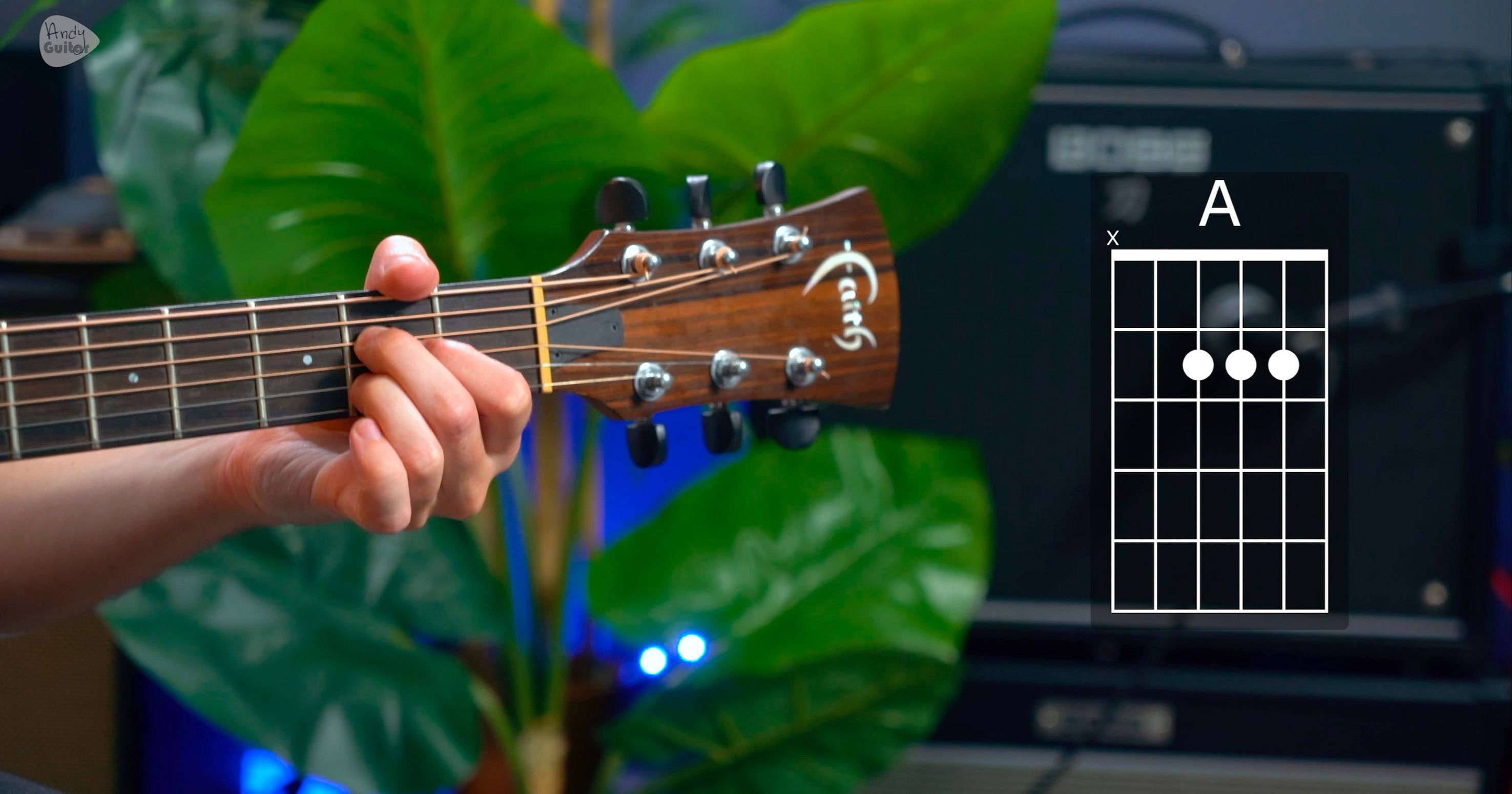
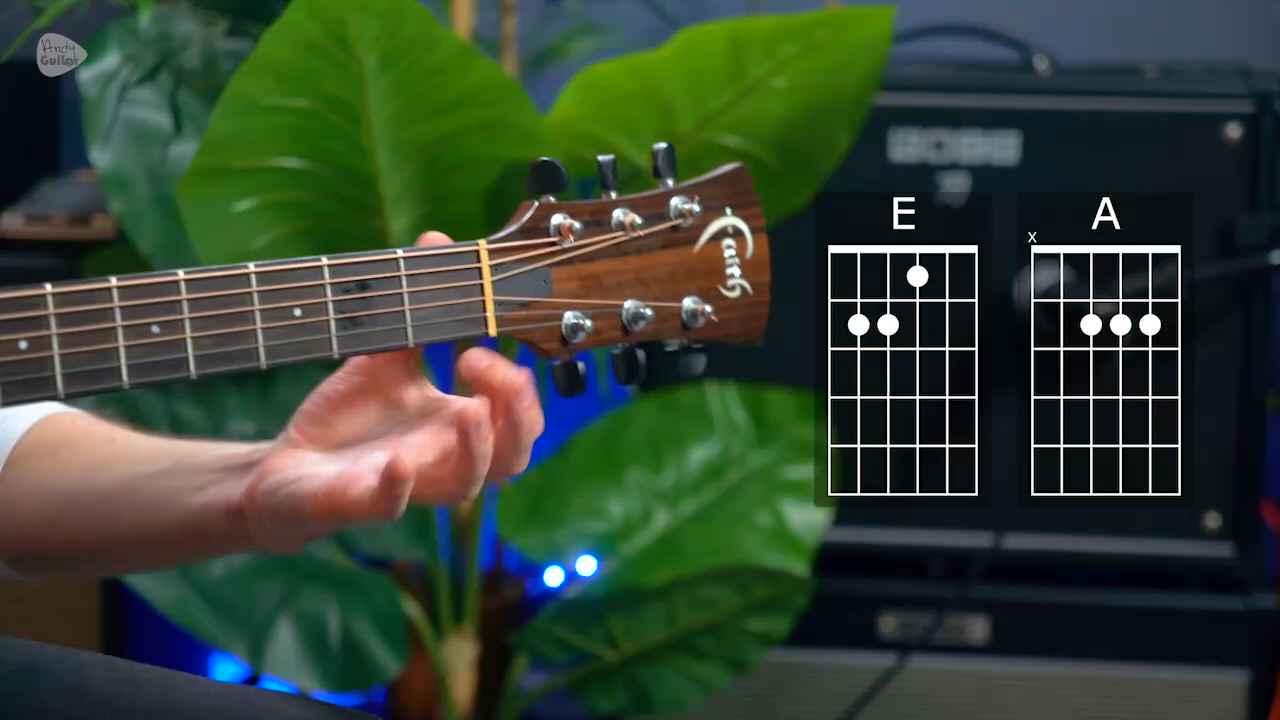
Here's how we play the A major chord which I recommend we play in this fashion, and it sounds like this. Some people will be more familiar with this fashion of playing an A major chord. And we can also play the same A major chord with the three weaker fingers, 23 and 4, and also with one finger. So if there is anything you do not like about this way of fretting an A major chord, do not panic, it's OK. For about 20-25% of people. There is an alternative way, one of those other ways can actually be better for you. Especially if you have absolutely huge hands, what some people refer to as sausage fingers. The one finger here can be a much better option. All 3 in a line, 123. Than this way. So why do I recommend this way? This way of fretting in A enables easier chord changes not only to the E major chord, where we can have an anchor finger or a pivot finger. But also enables that same pivot finger for the next chord, which is typically a D major. This makes the chord changes easier, which is for most people, the trickier part, not just learning an individual chord, especially with E, A, and D. So I'm gonna really encourage that you stick with this and persevere with this way of playing an A major chord, it is still my default. To this day, when I'm playing guitar, and it also makes other things more comfortable as well, which we'll talk about, but first of all, how do we play this? The index finger goes at fret 2, string 3. And we need that a little further back so that we can fit the middle finger in directly above it and the 3rd finger below. We then strum from string 5. And drag the pick down our strings or drag your first finger. Or even your thumb. Either way, we're not wanting any dead strings. From string 5. I can also get a pen or a pencil between the palm of my hand and the bottom of the guitar where string one is, which guarantees. That string one rings out, even with my thumb a little bit higher. That will take a little bit more practise, that won't all fall together at the first attempt. But that's what we're working towards, and we might be working towards that for the next few weeks. It's not gonna stop us or prevent us moving on from this course or stop us doing anything. It's just something to be aware of, we're never gonna get perfect chords. For any new chord that you learn, plus it's a new skill, so don't worry about that, it'll still move on if your chords aren't ringing out perfectly, but what can we do to make sure we're making this A major chord ring out perfectly, it all starts with sitting back in your chair, elbow in. Fingers right on their tips, thumb, even if it's sat on top, not over the top, a little bit lower than you might otherwise be positioning your hands, and make sure you're not hitting, string one with the underside of your palm, kind of like this, which puts everything into a bad position. If this doesn't ring out when you pick every string. You might have to adjust the pressure and press down a little bit harder only when you're picking. If you happen to have longer nails, this can be trickier, however it can still be done. You just need to have your fingers a little bit flatter. Check out the videos of Dolly Parton playing all these basic open chords with really long nails. It can be done, but she has managed to learn how to still get all the strings ringing out, but with much flatter fingers and not staying right on the tips. That does make it much harder. Nice short fingertips on both sets of fingers will make all chord playing easier. Finally, let's have a look at how to change between the E major and A major chords, which will enable you to play a lot of songs, even at this first level and play along to the jam tracks that we have coming up. Starting off with the E major chord, that was 123, like this. We want to lift off the middle finger and the third finger together. Slide the 1st finger over to the 2nd fret, have that middle finger above, 3rd finger below, and strong. And only be pressing down just before you strum, we're gonna have to do this nice and slow to build it up. When we move back, middle finger off and third finger off together as a pair, slide or scooch back to that first fret, Middle finger, 3rd finger, there's our E major chord. But working towards lifting off together, scooch, and pressing down together. So this is something that you can even do without strumming, and if you have a good eye and can just keep it, you're not gonna be able to see every string on your fretboard really clearly when you're learning these chords. So you'll have to reach over or even get a mirror when you're first doing this, but over time, you'll be able to feel it. And you'll be able to just look down and just see the top of your strings, but not each individual string, but you'll be able to feel how to change and get that instinct without even looking. We're gonna have to train that bit by bit, doesn't have to be perfect to be able to move on from this video. But what we're looking for is to get to a level where you can lift off together. And slide to that 2nd fret and press down together within a second or two, so 1. 2 That's absolutely fine. I'm still not pressing down to the fretboard, just touching the strings at this point, and that's what I encourage you to do as well, at this chord change in time, and then see how quickly you can do it. You can do an exercise where you time how many chord changes you can do within a minute, that's fantastic. Or just see how quickly you can do it. And again, doing it without pressing down too much is fantastic. Then as a separate exercise, do the same thing but strum every time, but do that as a separate exercise cause you'll have to press down harder and that squeeze and relax is something we're wanting to train incrementally. So start off with the E major chord, play an E major chord with me now. We lift off, scooch, press down together, bonus points if you can get that thumb sitting on top, but that's gonna come into play later, really in the second half of this beginner's course, so you can keep the thumb low for now, that's absolutely fine, and strung. Lift off, scooch, E major. Lift off, scooch, A major. Liftoff, scooch, E major, lift off scooch, A major. And just see how many of those you can do. When you're moving, as a final point, when you're moving here, you can relax and unsqueeze when that first finger has to move. Try not to keep the same pressure on that first finger when we're slide in it because it will hurt more. And it doesn't have to if we get used to this squeeze, relax, squeeze, relax, squeeze, relax. And if you are anywhere near that, you can move on from this lesson, but this should form the first part of your practise routine every time you pick up your guitar for the next few days.
In this video
Here is our second chord, the A chord.
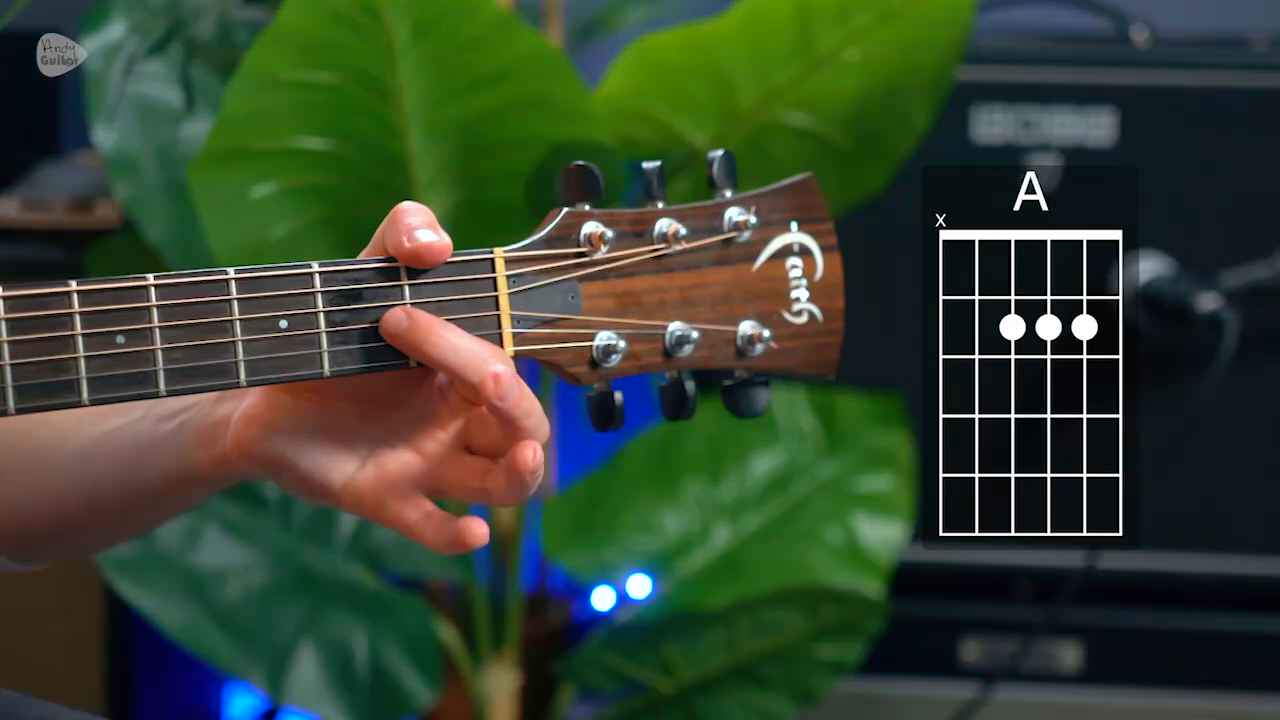
5 Tips to play a chord from muscle memory!
Look at the chord diagram, create the chord shape a note at a time in the correct place on the fretboard
Strum the chord to hear what it sounds like
Look at your fingers to memorise the shape but even more importantly, remember how the shape actually feels in your fingers
Do this exercise repeatedly but don't press down fully to strum the chord each time, just focus on holding the shape when committing it to muscle memory
More A chord options + tips
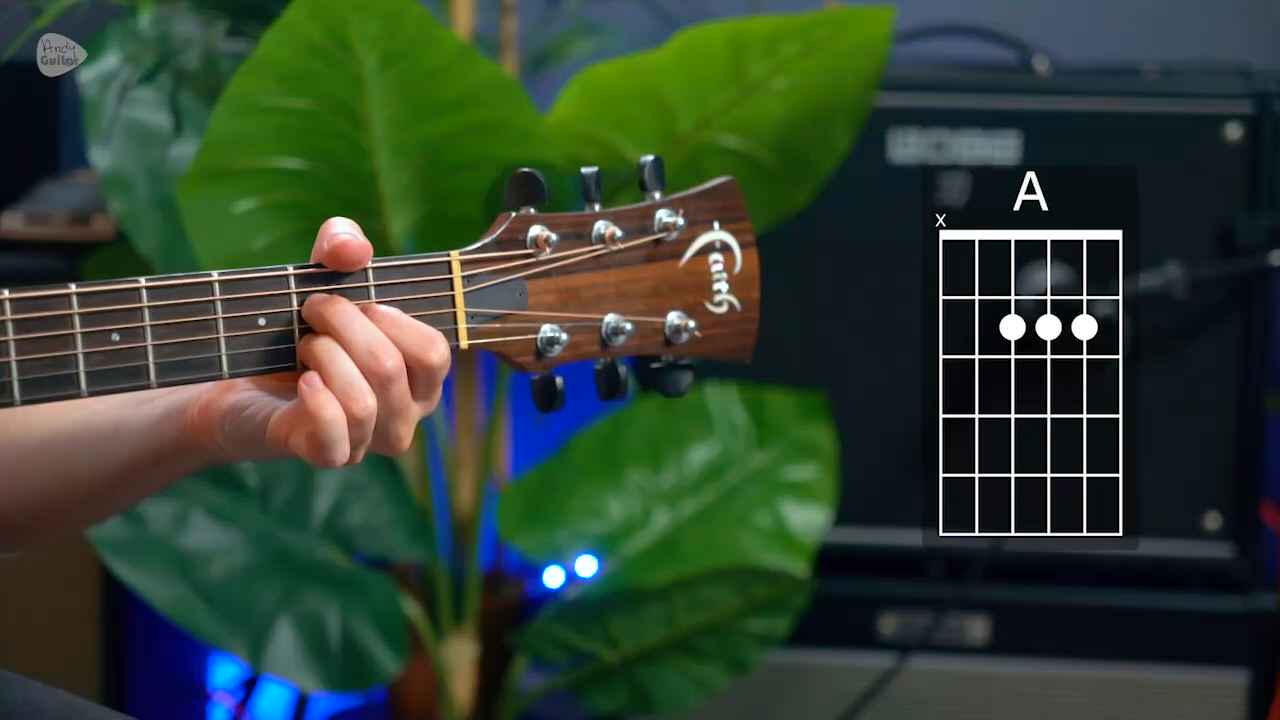
E to A change
Open String Names
You’ll need to know the names of the open strings. Using a mnemonic can help you remember them. For example; Elephants And Donkeys Grow Big Ears to remember E A D G B E (thickest to thinnest!).
Another student favourite to remember the open string names is Eddie Ate Dynamite Good Bye Eddie!
Memorising open string names is essential for tuning your guitar. Learn how to tune your guitar here.
Beginner Level 1
Recommended Songs
Enjoying this course? Want to test out your new skills? Find out my recommended song tutorials that accompany this course and get total access to the site by signing up today!