
The E Major Chord
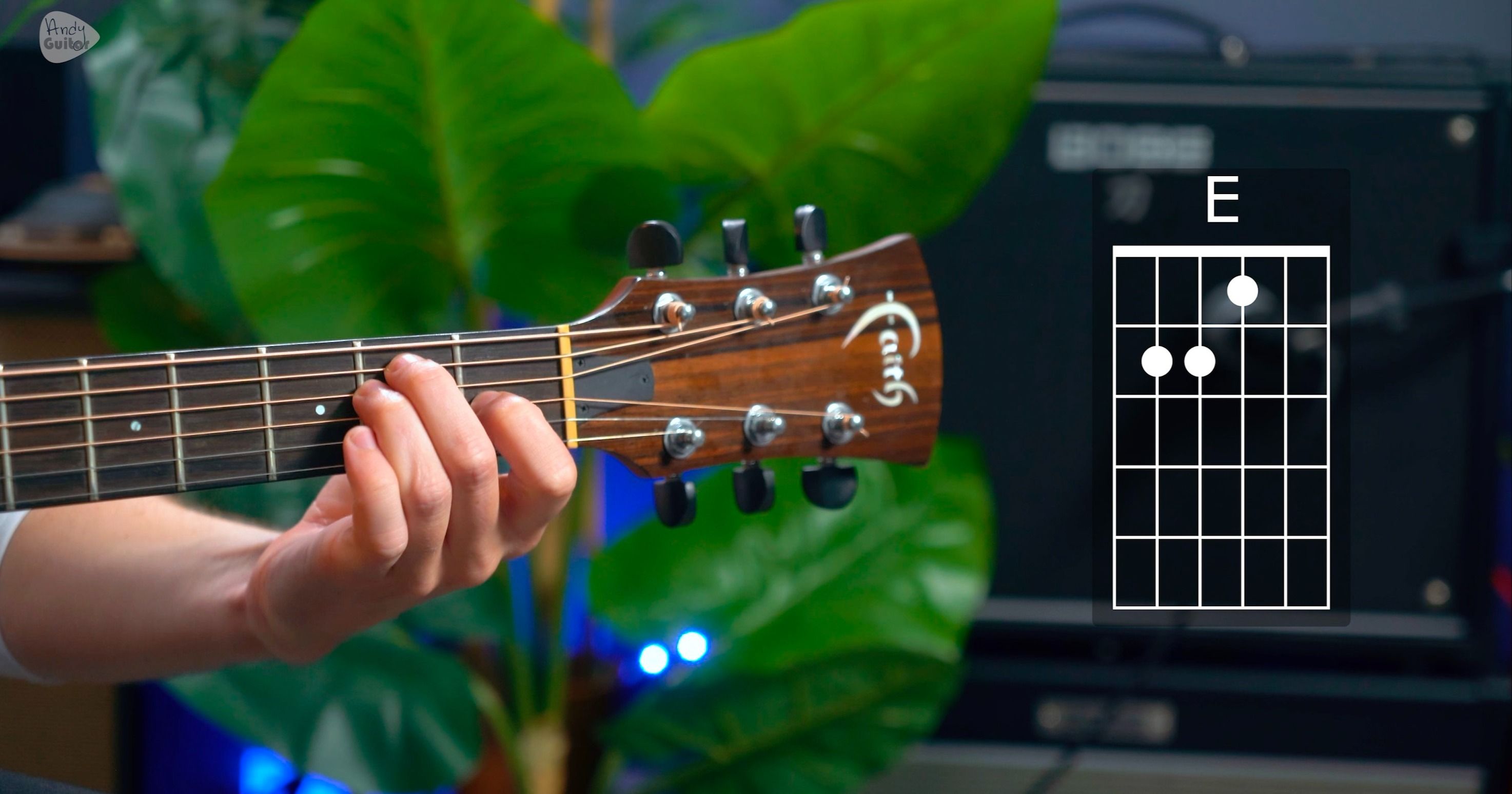
Here's how to play the E major chord, and this is what it sounds like. This is one of the fundamental open chords, which just means a chord that uses open strings. And this features in loads of songs, really fundamental chord. Let's make sure we can play it in the best way possible, which is by having the first finger at the first fret of string 3123. And we're gonna put that first finger right up against the fret and have it really curled over. We're then gonna put the middle finger on the second fret of string 5. Finger 3 On string 4, fret 2, the thumb wants to sit just above the middle of the fretboard at the back of the neck, but having it just creeping over the top but not sat on top is absolutely fine. What we want to make sure is that we have some space and that we're not touching strings 1 and 2, because all six strings. Should ring out To memorise this chord and any others, we want to be memorising the shapes, so we have this in our muscle memory, as well as where to place your fingers. To do that, make sure you're placing your fingers in the correct place first by placing them down one at a time, but then try and keep this shape under your fingers and lift off by maybe 0.5 centimetre to 1 centimetre and then place them back down. And lift off And placed back down. And when you're pressing down, only press down so that you're touching the strings, not even down to the fretboard while you're still memorising a chord. We don't want to be solidifying any tension in your hand, because any excess tension is going to make it harder to untrain that tension when it comes to changing chord. So just touch the strings. Not down to the fretboard, just keep your fingers still, lift them off by 1 centimetre, and then back down. Lift them off by 1 centimetre and then back down. It's a great idea to have your little finger kind of hooked in when you're doing this as well, rather than sticking out like this, which just encourages flying fingers and has actually made my whole hand a lot more unstable. So in the correct position, 123, but that's not gonna be how we practise it, we're gonna practise it by lifting off and going back down, lifting off and going back down. And just 30 seconds of this will help commit the E major chord to memory and also help when it comes to changing chords. Now that we've got this chord under our fingers, we're gonna now, as a secondary thing, make sure it's sounding good. The first thing is. All just left-hand training, entire focus on the chord playing hand. As a secondary thing, we're then gonna press down hard enough that we're holding all three fingers down with equal pressure and just drag the pick down all six strings. Or you can do this with the thumb. Or with the nail of the first finger. And then relax, you'll feel the difference there with the tips of your fingers, so do that sparingly, but practising actually where you put your fingers and then lifting off, shouldn't hurt your fingertips at all. It can just be a little uncomfortable because this is a new skill. While we're on this chord, here's 5 tips for perfect open chords. Tip number 1, as I've described, when you're practising it, you don't need to press down to the fretboard, just touch the strings. This saves your fingertips. Tip 2, you want to be sat with your lower back having support on any chair that you sit on, right back, shuffle back into the chair and keep your fretting hand, elbow into your side. Number 3, keep your fingers curled over and you're gonna feel like a bit of a T. rex. an animal when you do this, but sitting all the way back into your chair, elbow in and curling your fingers is the technique that we want to use. When we're fretting the E major chord, have those fingers right up against the fret wire, not in the middle of the fret. The further any fingers are at this side, the more dead strings, buzzing. And no it's not sounding good, it's gonna occur at this side of the fret. It's gonna sound better for less pressure, but that pressure needs to be just enough to hold the string down for it to sound. And finally, if you grab a pen or a pencil, when we play the E major chord, we should be able to thread a pencil between your fingers and the palm of your hand and the bottom of the guitar, especially those thinner two strings, otherwise they won't ring out. For them to ring out like this, we want to be able to get a pen or a pencil through there, ideally. That is done. By just having that thumb a little bit lower, which also straightens out my wrist as well. If I'm here, the thumb's over the top, my wrist is actually a little kinked there, and it's actually nice and straight or with a slight arch when my thumb is just that little bit lower. Just a couple of minutes' practise of that cord and you'll be ready for the next video, and I'll see you there.
In this video
This is the E major chord.
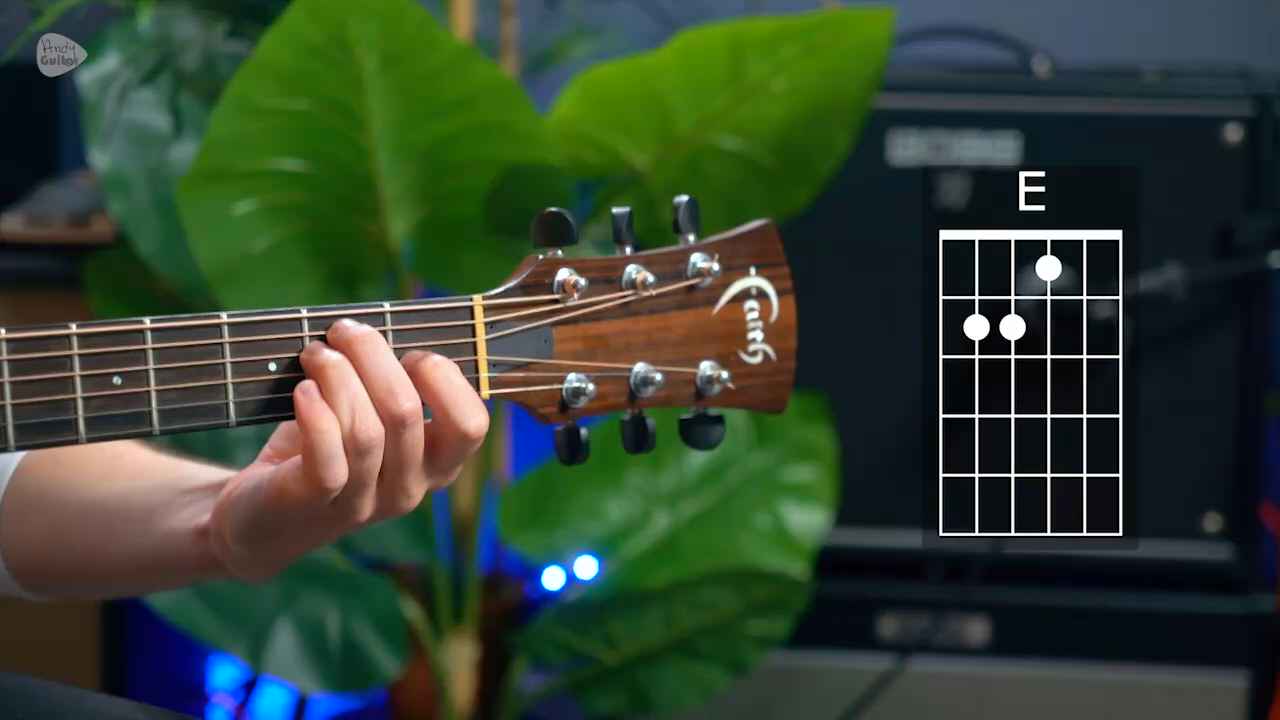
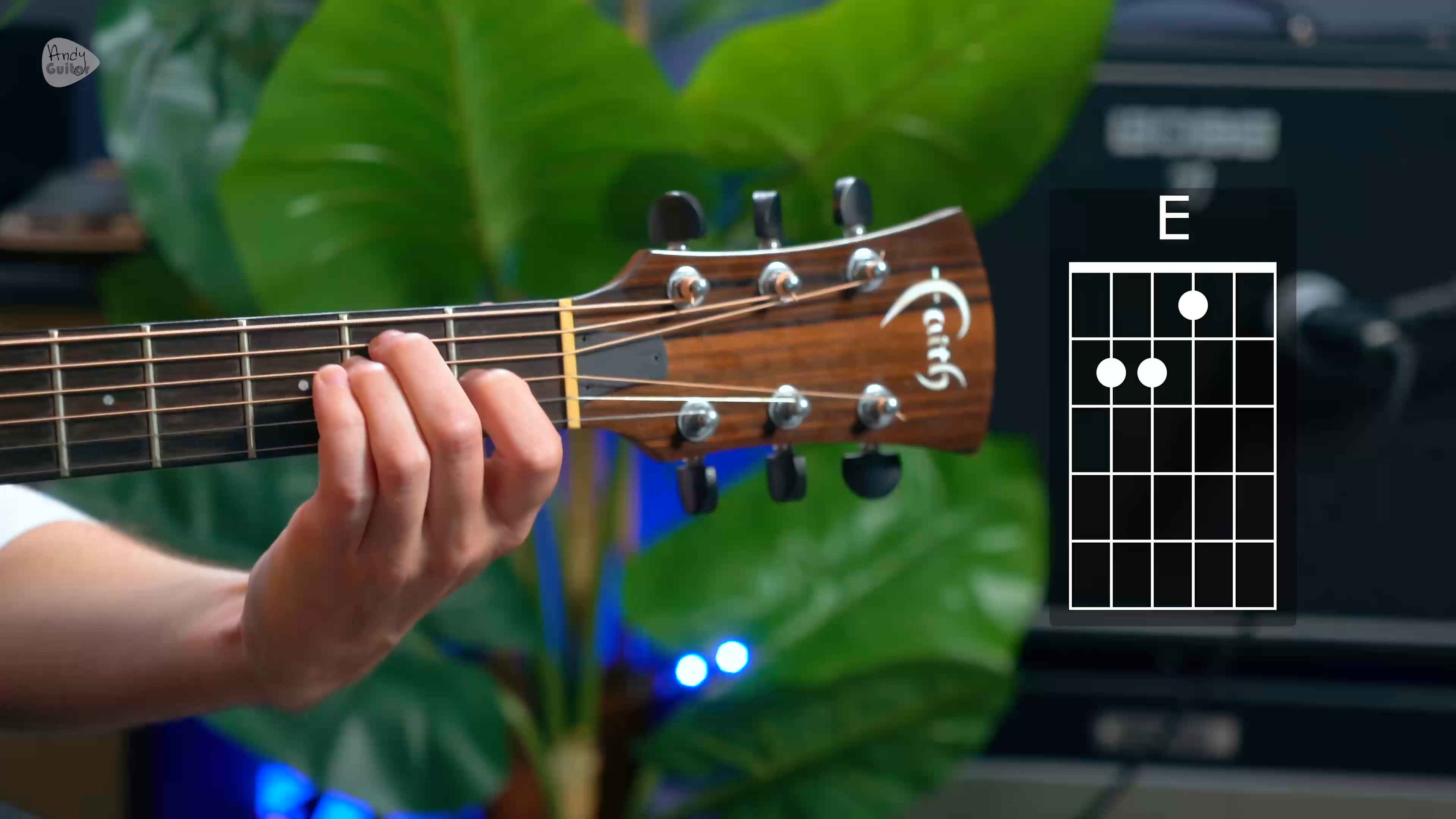
Chord Diagrams show us where to put our fingers for each chord. Here is the E Major Chord (aka E maj for short).
The white dots show where to put our fingers. In this chord, we strum all six strings on the guitar.
Many beginners feel that chord boxes and TAB can look 'upside down'. Many left handed beginner guitar players feel that chord boxes can appear 'back to front'.
In the video below video, I explain why this can be the case and hopefully help you to understand how to read chord boxes better.
See a complete video of how to read chord boxes and TAB for total beginners here
Memorise chord shapes
5 Tips for Perfect Open Chords!
These 5 tips provide the solutions for many smaller problems that crop up most of the time when we first start playing! Here they are:
Don't always press down a chord when first learning it, instead hover it over the strings to engrain that shape in our muscle memory (this helps reduce finger tips pain!)
Sit in a chair that firmly supports your lower back while keeping the elbow of your fretting hand arm tucked into your side (this helps with the wrist + chord placement)
Curl your fingers over, like a 'claw hand', so your finger tips actually fret the note (mainly helping strings ring out clearly)
Position fretting fingers next to the closest metal fret wire going toward your strumming hand, not in the middle of the metal frets or toward the tuning pegs (this helps notes be much easier to play!)
Try leave a gap so that you could place a pencil between your fingers and the bottom of the fretboard, this is the clearance needed to let all strings ring out!
Hopefully this has enabled you to play the E chord and it's sounding great!
Beginner Level 1
Recommended Songs
Enjoying this course? Want to test out your new skills? Find out my recommended song tutorials that accompany this course and get total access to the site by signing up today!