
Major Lead 01 - Major Scale Position 1

Hey guys, and welcome to this free little mini series of videos where I'm showing you how to play lead acoustic guitar. Now, in this particular series, what I'm gonna be referring to, and what I'm gonna be uh sharing with you some ideas of how to get started with, is soloing over um the chords that are in a major key. So for example, if we're in the key of C, those chords would be C, F. G major, A minor. And also in E minor and and other related chords. But the principles that we look at here, I'm gonna show you how to transfer them to any major key, so the key of G, the key of D, key of A, whatever it may be. Um, everything here is going to be very transferable and, um, quite different to the things that we've looked at before. Really on this channel we've only focused so far on how to uh play minor pentatonic style solos, so this kind of thing. That, that kind of thing, so very much based in the minor pentatonic position one. However, um, as I've covered in the live streams that I've been doing recently and and in my live workshops, that doesn't apply, or we, we can't use that, those scale notes um to play over something that is in a very major key. Again, using what I what I call the diatonic chords in the key of C. So we're gonna be starting super basic with this, and some of you may have seen some of this on, on the live stream that I did a little while ago. Um, however, we're gonna be starting with the absolute basics, which is, uh, begins with the C major scale, and the easiest way we can play that scale is in open position like this. Now there are already a couple of videos of mine on YouTube showing you exactly how to play that scale and how to play loads of melodies, uh, using those scale notes, such as Happy Birthday and things like that. If you want to see those and you and you think that's, you know, you're not yet at a level where you can play that, click the link just here and it will take you to those videos and um get you started with this more major or even get you started with single note playing, if that's something that you have not done yet. But where I would like to um push on from here is covering something new to my channel that I have not really covered at all, and I, I should have done by now, that's why I'm doing these videos. And that is uh the major scale in position one. Now I've, I'll be doing other videos on exactly what these positions mean, so position 1, position 2, etc. But the one that we're gonna be focusing on is this. So it begins with our middle finger. On the 8th fret of the thickest Estring, and if I just give you a quick playthrough of it. If that is something that you, is either brand new to you, or you've kind of covered it in the past but you need a refresher on it, that's what this video is about. If you're wanting to kick on and you already know that scale ship, click on to the next video in in this series where we'll kicking. On how to use this for improvisation and how to make learning lead lines that are more major based much easier for you. But let's have a look at this scale uh a little bit more in depth and learn how to play it for those of you that haven't covered it before. So as I say, we start with our middle finger. Which is different to how if you've done the, uh, and this would be a C note, so C uh at 8 fret of the thickest Estring. And many of you may have covered the minor pentagonic scale. If you haven't covered this scale, you should probably start with that one. It is, it is much easier, that minor pentatonic. I have lessons on it, just how to play the, the minor pentatonic scale. But with the major scale in this position one, we need to start with the first finger. And we're gonna always use the little finger and assigning a finger to a fret, that would be uh at the 10th fret. So middle finger at 8. Little finger, a 10th fret. The next note would be the first uh finger as 7th fret of string 5. And therefore we we start to hear this sound, do re mi. Now it's really important to note that these are the exact same notes, same letters, everything, C, D, E, as in the open position one that if you're still watching this video here, you should already know. Those letter names are C, D, E, C, D. So by learning this, we're not necessarily learning any other letters, which is why I really think you should learn how to make music from the er open position one first. er um but. What we are giving ourselves is is higher notes, so we can go over two octaves here, which is C to C and then to C again, so going much higher. Um, then we can go in open position and that's the one of the many advantages of of learning this when when we learn it in this fashion. So do re mi. Or CD. Then we play the same frets again, so uh uh 8th fret and then 10th fret, but a string down. So do re mi fa sol. Now those are by far the most important notes that you need to learn, specifically because of the next lesson in this series. Do re mi fa so. If you do nothing else in this first video, you can just learn those 1st 5 notes and memorise them, and the, the tab for everything that we cover here is, is on the website. Uh, links in the top corner and or in the description below. You see the tab written out, it's all totally for free, that you don't have to sign up to get my tabs or anything. They, they're totally for free. And um, that you can kick on to the next lesson if you wish. However, what it's best to do. Is learn the full scale shape, which would then be 7. 9, so the third finger this time, to little finger. And if we can get that far, it it it it can get harder to learn later on, but there's a pattern that we can learn that makes it super, super easy. Don't get lost as we go down the strings, um, but the thicker ones are a little easier. So. 88 threats, 10. 7. 8, 10. And we have to use these fingers as well, so make sure you're doing that, but then we're on 7. 9 10. Now I mention that it can be easier for the next part cos there's a pattern and it's 79, 10 again. 79, 10. So those middle two strings. Exactly the same, um, but it is good to, when you're first learning to start from the beginning because I want you to be really paying attention to the sound of this. This is the major scale and it is how we play a lot of melodies, how songs play melodies. So you have to be familiar with this sound as you're learning it. Let's have a recap for how far we've gone so far. Sticking just to the uh major scale to to the C octave, uh we've just got 4 more notes now, so you're nearly there. It's middle finger on the eighth fret. Little finger on 10. And those are on the B string, so 8 and 10. And then 7 and 8. Now to finish off the scale of ship, which is um every note that we can play in this position one, we can also play the little finger on a 10th fret as well, but it's important to know that that's the C octave, just like our barcodes. And therefore we've gone through one C note. Um, and 2, so 2 octaves in total. There's the first octave. And there's the 2nd. We do also want to practise this as well as going up the scale, so down the fretboard. We want to practise it coming down, so descending as well. And I think too many people just or too many beginners can learn scale shapes just from the thickest string. So it's important to be able to play it from the highest note and to practise it and even start playing. From the thinnest and and the highest note also, um, because as many melodies will come down as will go up, um, so let's just have a little bit of a recap of that, but it will be exactly the same notes. And it is best to practise it with what we call alternate picking, so with a down, up motion, no matter what note is played. There's our highest note, and then we just come down the exact same set of notes. And that is position one of the major scale, and we started on a C note, so it was the C major scale. However, the real advantage of learning it here, um, as, as well as in the open position, is if we want to play the C major scale, we just move this scale shape up one fret. And it sounds very similar, still sounds like the major scale, cos that's what it is. Do re mi fa al, and once you've learnt it in one position. It is easy to transfer that up and down the neck or easier than learning a new scale, certainly, cos it's the same finger motions, the, the finger, uh mechanics of it are the are the same. So all you need to know to be able to play now, if you've learnt that, the, the major scale in any key. I just know the the notes that are on the thickest string, so from the F and the F, G, etc. etc. I have a lesson on that, um, as part of my beginner's course where we'll cover the notes on the thickest string. And um that's it. So for example, wanted to play this in the key of E, we would start at the double dot at 12 frets. And you're playing the E major scale. Um, but that's everything that we're going to cover in this lesson. If you need more of a breakdown, more written content, more, um, you know, uh, more help with this and, and the tab, it's all for free on the website. That link is in the top corner and in the description below, and, um, I really hope this serves you and helps you play some major scale sounding solos and how to learn major scale style songs and lead lines, uh, but we'll get onto the next video right now.
In this video
Acoustic Lead Guitar Major Scale eBook 2021
Welcome to this free lead guitar course where we're looking at how to solo using the Major Scale on acoustic guitar!
This is ideal for anyone wanting to learn how to improvise to create solos, or if you want to just learn the techniques to enable you to play higher level guitar solos.
This first video will show you how to play the Major Scale over 2 octaves, in what is known as 'position 1'.
Major Scale Introduction
The major scale is a 7 note scale. It is the foundation of all western music. While the minor pentatonic scale can be more commonly used in Rock and Blues solos, the major scale is used in all, yes ALL other genres including pop, folk, country and even major sounding Rock songs.
The easiest way we can play this scale is in open position. This is covered in my Beginners Course here, which you should be confident with before proceeding any further with this course.
Major Scale Position 1
So that we can play this scale in ANY key, we need to learn it in a higher position on the neck. This means we can learn this 1 shape, and move it up or down the neck to play it in any key! The most popular and common position to do this is Position 1, shown below.
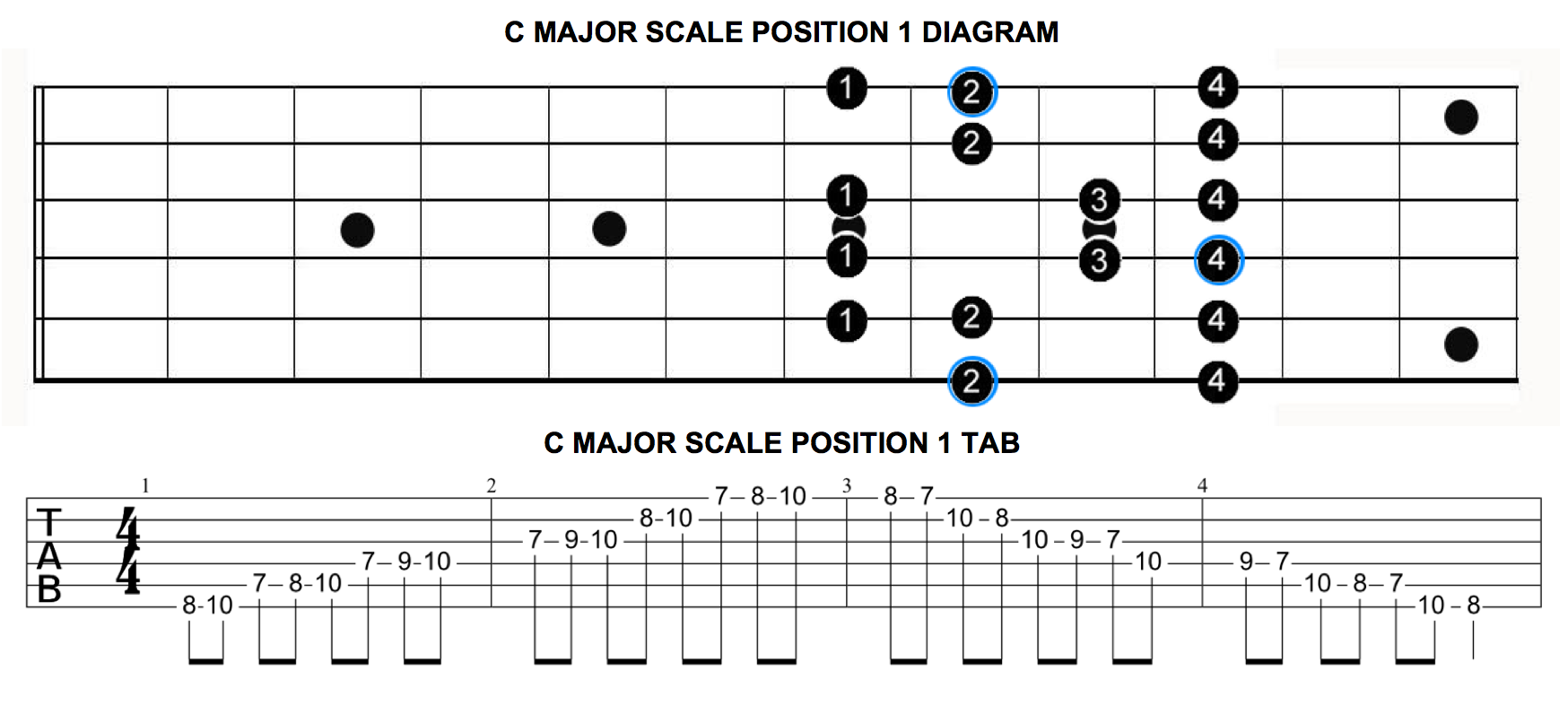
The first note (Fret 8 on the thickest string) should be played with the middle finger (strange if you are note used to it). The little finger is also used on every string, making it tougher to learn than the minor pentatonic.
If you really, really struggle with playing this, try these finger exercises first to get your fingers to coordinate better.
This bit of the course is the most physically challenging bit to play. From this lesson onward, the focus is far more on creativity and smaller patterns on the fretboard. So please, put the time in now to learn this scale correctly and you will reap the rewards later in this course!!