
In this video
In this live lesson, Fraser on guitar and Tom on drums break down the 12 bar blues, one of the most important progressions in music. We cover how the progression works, how to find the chords in any key, the classic blues drum grooves, and how minor blues changes the whole mood. Backing tracks in the key of A, with each of the grooves from the stream, will be added to the lesson page so you can practise the 12 bar blues yourself.
THE DOMINANT 7TH SOUND
Much of the classic blues sound comes from the dominant 7th chord. It combines the root, the major 3rd and the flat 7th, which gives it that bluesy tension. If you know the B7 chord from Beginner Acoustic Level 6, you already know this sound. The tempo and groove you play it with completely change its mood.
THE I IV V CHORDS
The 12 bar blues uses three chords, known as the I, IV and V. In the key of E, these are E, A and B. To find them in any key:
Play the root as a power chord on the 6th string. This is your I chord.
Play the same fret on the 5th string. This is your IV chord.
Move up two frets on the 5th string. This is your V chord.
For example, in G you have G on the 3rd fret of the 6th string, C on the 3rd fret of the 5th string, and D on the 5th fret of the 5th string. This L shape works anywhere on the neck.
THE 12 BAR FORM
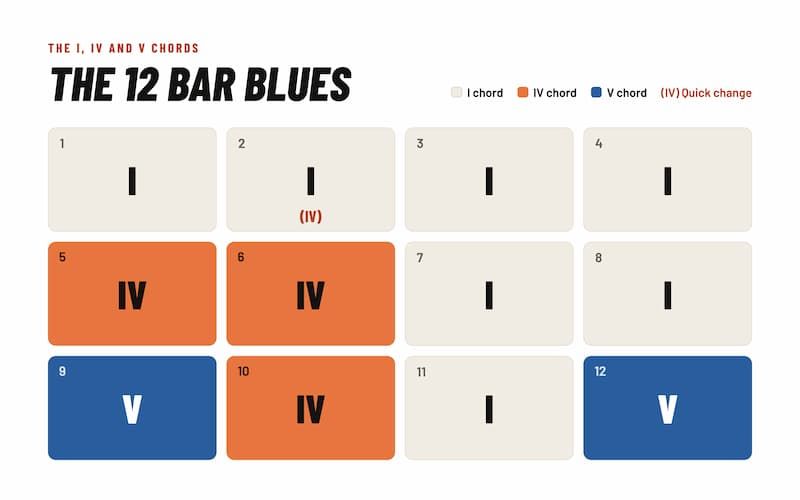
Here's how the 12 bars are laid out:
Bars 1 to 4: the I chord
Bars 5 and 6: the IV chord
Bars 7 and 8: the I chord
Bar 9: the V chord
Bar 10: the IV chord
Bar 11: the I chord
Bar 12: the V chord, leading back to the start
For a variation, try the quick change, where you move to the IV chord in bar 2 and back to the I in bar 3. It breaks up those first four bars nicely.
THE TURNAROUND
The last four bars are the turnaround, with one bar each of V, IV, I and V. Ending on the V creates tension that pulls you back to the I chord and the start of the progression. A helpful way to think about it is that the first four bars are relaxed, the middle builds, and the turnaround is the exciting bit before it all starts again. Train your ear to hear this, as it helps you keep your place when jamming.
For lead guitar, a great starting point is to target the root note of each chord as it changes. Over the B chord in E, bend the 14th fret of the G string up a tone to B, then release it back to A for the IV chord. You can also follow the chords by moving your pentatonic shape to each chord's position. Another useful tip is to play major pentatonic over the I chord and minor pentatonic over the IV.
BLUES DRUM GROOVES
We looked at three essential grooves:
Half time slow blues: a slow, heavy feel with a triplet pulse, counted "1-2-3, 2-2-3, 3-2-3, 4-2-3". We opened the stream with this on "Red House" by Jimi Hendrix.
Shuffle: the classic blues feel, with a swung, triplet-based bounce. In notation, you'll often see a shuffle symbol rather than written triplets. Listen for how a straight rhythm clashes with a shuffle until both players lock in.
Straight 8s: an even, driving rock and roll feel, as heard in "Johnny B. Goode" by Chuck Berry.
We also demonstrated stop time, where the band plays a riff or stab and then stops to leave space, as in "Hoochie Coochie Man" by Muddy Waters. The stabs at the start of "Johnny B. Goode" also fall within the first four bars of the progression.
MINOR BLUES
Minor blues uses the same I IV V pattern, but with minor chords. In A minor, these are Am, Dm and Em. Many players use an E7 at the turnaround to add tension before returning to Am. The result is darker and smoother, and bringing in the natural minor scale adds a jazzier feel. For classic examples, listen to "The Thrill Is Gone" by B.B. King and "Black Magic Woman" by Fleetwood Mac, later made famous by Santana.
A LITTLE HISTORY
Blues began in the Mississippi Delta in the early 1900s, with acoustic Delta blues developing through the 1920s and 30s. It then moved to Chicago with players like Muddy Waters, Howlin' Wolf and Buddy Guy. Texas blues followed, leading to Stevie Ray Vaughan, while the British blues boom brought us Eric Clapton, Peter Green and the Rolling Stones.
CHAPTERS
00:00 Opening jam: Red House
02:59 Welcome
07:50 Guitar tone: Marshall DSL40, Boss Blues Driver and reverb
11:40 Half time slow blues groove
14:00 The shuffle and why blues is the foundation
15:40 The dominant 7th sound
19:25 The I IV V progression
20:55 The blues turnaround
23:50 The 12 bar blues form
32:55 The turnaround explained
36:15 The quick change
38:40 Turnaround licks and following the chords
44:20 Finding the I IV V in any key
47:35 A brief history of the blues
49:35 The three main blues drum grooves
55:00 Stop time
56:00 Half time jam in C sharp
1:02:40 Major over the I, minor over the IV
1:03:25 Straight 8s: Johnny B. Goode
1:08:00 Minor blues
1:19:20 Final minor blues jam
KEEP LEARNING BLUES
Check out these Course modules for more Blues action.
Beginner Electric Level 3: Beginner Rock & Blues Rhythm Basics
Beginner Electric Level 6: Beginner Electric Blues & Chord Embellishments
Intermediate Acoustic Level 8: Solo Acoustic Blues & Solo Fingerstyle Methods
Jazz Starter Kit (more I IV V progression)
Thanks to everyone who joined us in the chat!
Rock n' Roll Straight Eighths - No Guitar
Try your 12 bar chord progression over this groove. Think Johnny B. Goode by Chuck Berry. Key of A, 145 BPM.
Blues Shuffle - No Guitar
Try your 12 bar chord progression over this classic Blues Shuffle. Key of A, 110BPM
Half Time Feel - No guitar
Try your chord progression over this half time feel Blues groove. Think Red House buy Jimi Hendrix

Enjoying this video?
Try this course - Beginner Rock & Blues Rhythm Basics
Continue your electric guitar journey with this Rock and Blues Rhythm Basics level.