
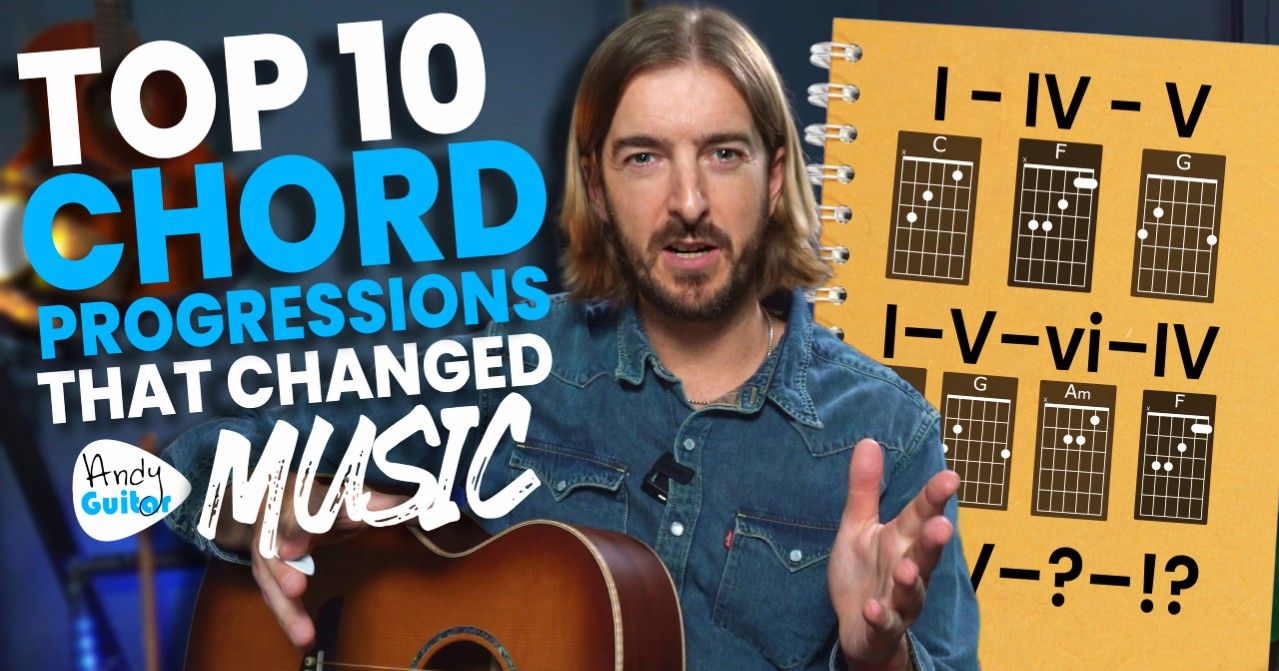
In this video
Most hit songs aren't built on unique chord progressions — they're reusing the same tried and tested building blocks that have been the backbone of popular music for decades. In this lesson, Andy breaks down the 10 chord progressions that have shaped the songs you know and love, using the Nashville number system to show you how the same patterns appear again and again across genres and generations. Whether you're a beginner looking to unlock your first songs or an intermediate player wanting to understand why music works the way it does, this one is packed with those lightbulb moments.
#10 — The Two-Chord Vamp (I–IV)
The simplest and one of the most powerful. Songs like Achy Breaky Heart, Dance the Night Away, I've Got a Feeling and Tennessee Whisky all live on just two chords. A great starting point for improvising with the major pentatonic scale.
#9 — The Aeolian Groove (i–♭VII)
When a minor chord sits on a groove without resolving, you get that folky, psychedelic rock feeling found in Working Class Hero, Masters of War, All Along the Watchtower, Dreams, and Jolene. It's all about the rhythm — the harmony almost takes a back seat.
#8 — The 12 Bar Blues (I–IV–V)
The foundation of rock and roll. Andy covers the progression in multiple keys with examples including Johnny B. Goode, Hound Dog, Before You Accuse Me, Sweet Home Chicago, and Folsom Prison Blues — plus a technique tip on thumb muting to get that classic ringing tone.
#7 — The Folk Progression (I–V–IV)
A step beyond the blues, this is the chord progression behind Twist and Shout, La Bamba, Leaving on a Jet Plane, and You Shook Me All Night Long. Simple on paper, but it's all about embellishing the basics and nailing quick changes between cowboy chords.
#6 — The Axis Progression (I–V–vi–IV)
The bread and butter of modern pop. Let It Be, No Woman No Cry, Someone Like You, and With or Without You all use the same four chords — what makes each song unique is what the artist does with them.
#5 — The 50s Progression (I–vi–IV–V)
The ice cream changes. Stand by Me, Earth Angel, and Every Breath You Take all share this progression. It sounds like the 1950s but it never really went away.
#4 — The Descending Bass Walkdown (I–V/7–vi)
When you add a walkdown bass note to your chords, everything gets more interesting. Landslide, Wherever You Will Go, and Songbird all use this trick — and it works at beginner and intermediate level alike.
#3 — The Andalusian Cadence (i–♭VII–♭VI–V)
One of the oldest chord progressions in Western music and still one of the most useful. Hit the Road Jack, Sweet Dreams, California Dreamin', and Genie in a Bottle all draw from the same well. A favourite of flamenco players, pub singers, and pop writers alike.
#2 — The Jazz Progression (ii–V–I)
The foundation of jazz harmony, heard in Autumn Leaves, Blue Bossa, and dozens of standards. Andy's favourite example is Mack the Knife.
#1 — The Beatles Progression (I–Imaj7–I7–IV)
Andy's pick for the most stolen move in guitar music. Something by The Beatles is one of the earliest examples, and you'll also hear it in Kiss Me and Maybe I'm Amazed. Move through the major 7 and dominant 7 before landing on the four chord, and you've got one of the most beautiful sounds the instrument has to offer.