
PAPANGU - ATG 2026
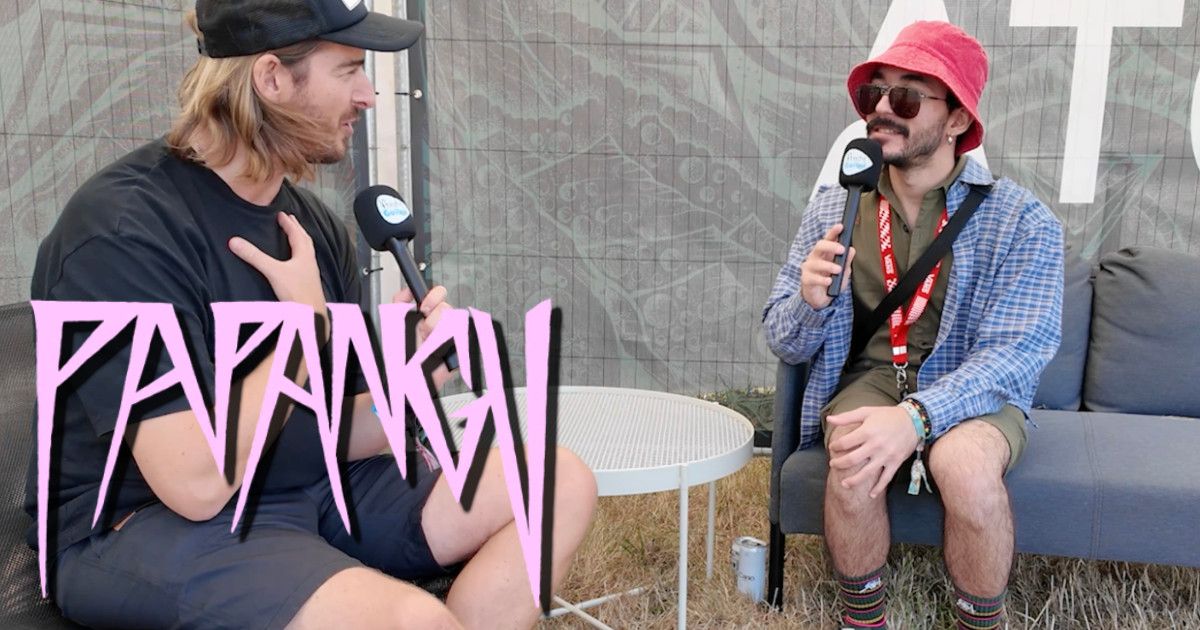
Hello, I'm Pedro Francisco. I'm a musician from Papangu. I play the guitar, I sing, I play the percussion and flute. Is that all? And rubber chickens, rubber pigs, um, whistles. We're at the Art tangent festival and uh you guys are playing later on. And you have such a range of influences. This, this is the one thing I want to really dig in with yourself. What came first instrument wise? Did you start on guitar or was there something else for you? It was a guitar indeed. I started on the acoustic because no one in my family had an electric guitar. nylon strings, nylon strings, just to learn a few chords and Nirvana, Beatles, Bob Marley. Then I. Then I bought a guitar and and started already with it. Was there a huge curiosity in yourself to pursue other instruments? Was that encouraged by your family? How did this? It was encouraged by my family, mainly by my brother, which is the keyboardist in Papangu, in singer, Hodofu. He played the piano before I started the guitar, so, uh, later on, after learning the guitar, I started also, um. Dribbling and and kind of making a few sounds on the piano until I also learned a bit of it and pur pursued these other instruments, as well as the bamboo flute, like, oh let me try a few notes here. And I've very much enjoyed listening to it over the past couple of weeks, in particular when we heard you were playing here, it's been lovely to do a deep dive on your music. It's such an eclectic instrumentation influences. How do you define the sound of Papangu? How do you, how do you put the reins on this to make it sound like a band, because it very much does. But that must be, that must take a conscious choice. Sure, it's, it's a challenge to mix. Such a diverse diversity, um, I mean, lots of different styles and genres into one unique, um, and every one of us has a different reference and uh inspiration. So when we mix it all in the pot, then it comes out as pan. I wouldn't know how to put uh a single um. You know, a single word to describe, but you wouldn't want to pigeonhole it, but I know it when I hear it cos it's a vibe, it's an absolute vibe. And I'd I'd love to ask you, you've been on tour in the UK, um, what's been a favourite song on the set that maybe, you know, fans of your band wouldn't expect? What's the, what's one of the best ones to play beyond the top ones on Spotify? I'm enjoying playing a song that. Was written for the Lumpy, our second album, I know we in the. The middle of Celestial which just came out, but there are songs which we are uh like unravelling and discovering and it's been, it's been such a joy to be on tour and bring out these songs as well because every time we play, we play a different arrangement, improvisation, uh, another instrument that we want to try out, uh, uh, a mini moo. So it's like every So now is more fun to play on the set because we have a mini mg. Um, but I will say Sohaya. And, and from the new album, I guess um a famous song, it's it's, it's a great one to play live too. Do you feel like you're still writing some songs even from the new album when you play them live? Keith Richards once said he's still writing Jumping Jack Flash cos every time he plays it live it's a little bit different. It's, it's the first time for that version. Do you feel the same yourself? I very much connect to Keith Richards in in that manner because, because we do, um. We do change every time. That's nothing like. Like the same. And even with instruments or is this just that you said arrangements, what do you mean with arrangements, which, which songs have changed the most? Yeah, you say you play with arrangement, what's changed the most? What's changed the most? Wow, it's a hard question. I think, um, San Francisco, which is a song we do since Olono, the first album, is a song that every time gets different because of its uh arrangement, because of its sections. So there is a section which is just free. Alsolado. Which is from the new album, uh, at the end, uh, pretty much every time we make it, uh, Harington, we kinda make it more slow, more fast, or Maybe I, OK, I will improvise here where, where there's no improvisation in, in the, the album that's placed, but I'll, I'll try out something else. Well, this happens a lot. Are you thinking about a certain scale, are you thinking about for this mix of influences. Um, I'm often teaching major scale, major pentatonic, minor pentatonic, and then modes basically. Are you thinking about this totally differently? Please share how you think about it. Depending on the song, if it's a song more close to our roots, traditionally as in for her, um. We tend to think of modes more as Molidian, also Dorian, it's quite common. Yeah, they're, they're the common modes that might, we might do, but they. Is that because of the chord progression you're playing over, I presume. As a guitar player, I'm much uh biassed to the chords, so I, I love jazz and this I mean it's a big influence, so I try to, to stand, to, to, to, to listen to the chord and then, Then improvised, this has to do a lot with Emeto Pascual that is a major figure for us in instrumental Brazilian music. He, he likes thinking of triads too. So sometimes we have a chord and we just think, oh, OK, which are the. The main triad options I can use over, I don't know, G minor. So I can use uh B flat, I can use, I don't know, F major over G minor, so, just, OK, have these two, let's let's try that. And do you think about the individual notes, or are you, are, are you more shapes led on the neck? Like do you visualise the shape? Oh yeah, in the, in the guitar, it's hard to get out of its shapes. So that's the thing, a lot of people learn the shapes first and then we have to break out of break out of them, of these shapes on the neck, right? Exactly. And because of this influence I have from Emeto and I would like to, to also talk about uh Erado du Monti, which is a. Uh, a great, uh, contemporary artist from Metal's, uh, time, and he's still alive. He, he's played, he plays the guitar and he, he, and I, and I try to think of, uh, scatting. So in my mind I try to think as I'm improvising with no instrument. So every note I play, I have to sing before. So that makes me. That makes, that makes it less of the instrument and more music, so the instrument is literally an instrument. 100%, but then it's more instinctive rather than the fingers can be quite predictable sometimes. Yeah. And if it's led by the mind and led by singing. Exactly. It's a lot of my favourite solos are basically just the melody. I mean Smells Like Teen Spirit. It's just the vocal melody from the verse, but it hits more because of that. Um, if there was one Brazilian piece, maybe a more traditional one, some of the people you've mentioned, um, there would be a gateway piece for a lot of our audience watching. What, what would you recommend for that? I would recommend a short album if. Of course, please do. Yeah. That is Quarte Novo. Um, it, it's, it's, it's I've just talked about, which is a very famous and it's traditional. Was it was in the 60s but it sounds like it could be. I mean it's, it's, it's very traditional instruments traditional Luis Gonzaga played the accordion it it's I think it's a good start for getting to vibe. These mixtures, you know. And I will make it my mission to learn it before the end of the year. I like that a lot. And there's so much influential um music from that time period in Brazil, in, in the 50s to 60s is like a peak of, of a lot of that, so much music ahead of of your time. If there was one song everyone watching of Papangupan that everyone should learn, which one would you say? Oh yeah, including me. So go easy on me, but I'll, I wanna know how to get this vibe, man. What would you say is the one I would say um. I would say Afima song because of its um because of it. Uh, it has, it has a guitar approach to it. It was composed on the, on two guitars, two acoustic guitars. OK. So it's over, it was based on chords. I mean, you can't go wrong on that. Of course, I look forward to checking out. What is the main guitar you have with you today? The main guitar? Telecaster. Telecaster, why, why a telly? It just, it just chose me. I didn't choose it. They do pick you sometimes don't they, but did you always have that in mind from a child or is that when you played it? I used to have a less pole when I just started, but. Uh, it was not for me. I later saw a Telecaster and I, and it, it chose me. I, I, I, I really stuck to it, stuck to it until today. Tele can do pretty much anything as well. It is just, it's a wonderful sound, wonderful instrument. I look forward to hearing it later today. Is there anything else you'd like to give a shout out? You guys are going to Europe tomorrow? Yeah, you continuing the tour? Anything you want to give a shout out to to promote? Well, um. I'm really just happy to be here. I'm happy that we're touring, that we're having such a, a great feedback and response from the, the public. So, uh, we're heading out to France, to Nantes, Nantes, Nantes, and it's going to be cool. I mean, we never played France and this time we also played for the first time, uh, Madrid at Spain, so. Back here in in England in was so cool. I mean we're hoping to come back more because it's, it's pretty cool playing here also. I hope so, we'll do all we can to promote it to get you guys back. We've been just absolutely vibing on your music the last couple of weeks in particular and yeah, looking forward to hearing you later on the big stage. Thank you so much Andy. Thank you.
In this video
Andy speaks to Pedro Francisco (guitar, percussion, flute and rubber chickens) from Papangu at ArcTanGent. Pedro started on nylon string acoustic learning Nirvana, Beatles and Bob Marley, inspired by his brother who played piano. From there he pursued percussion, bamboo flute and eventually a full eclectic range of instruments, all of which feed into Papangu's hard-to-define sound.
The improvisation conversation is one of the best in the series. Pedro talks about using Mixolydian and Dorian modes with a jazz-influenced chord-based approach, and the technique of singing every note internally before you play it so that the instrument truly becomes a vehicle for musical ideas rather than muscle memory. He credits Brazilian composer Eduardo de Monte for that approach.
The band plays differently every night, with different arrangements and spontaneous choices. He recommends the Quartetto Novo album as a gateway into Brazilian music, and his main guitar is a Telecaster that, as he puts it, chose him rather than the other way around.
Enjoying this video?
Try this course - Metal Lead Guitar
Learn the essential techniques of metal lead guitar - 3-note-per-string scales, legato, and arpeggios - with jam tracks, economy picking, and a simple approach that gets you playing fast and sounding great from day one.