
How To Use Delay
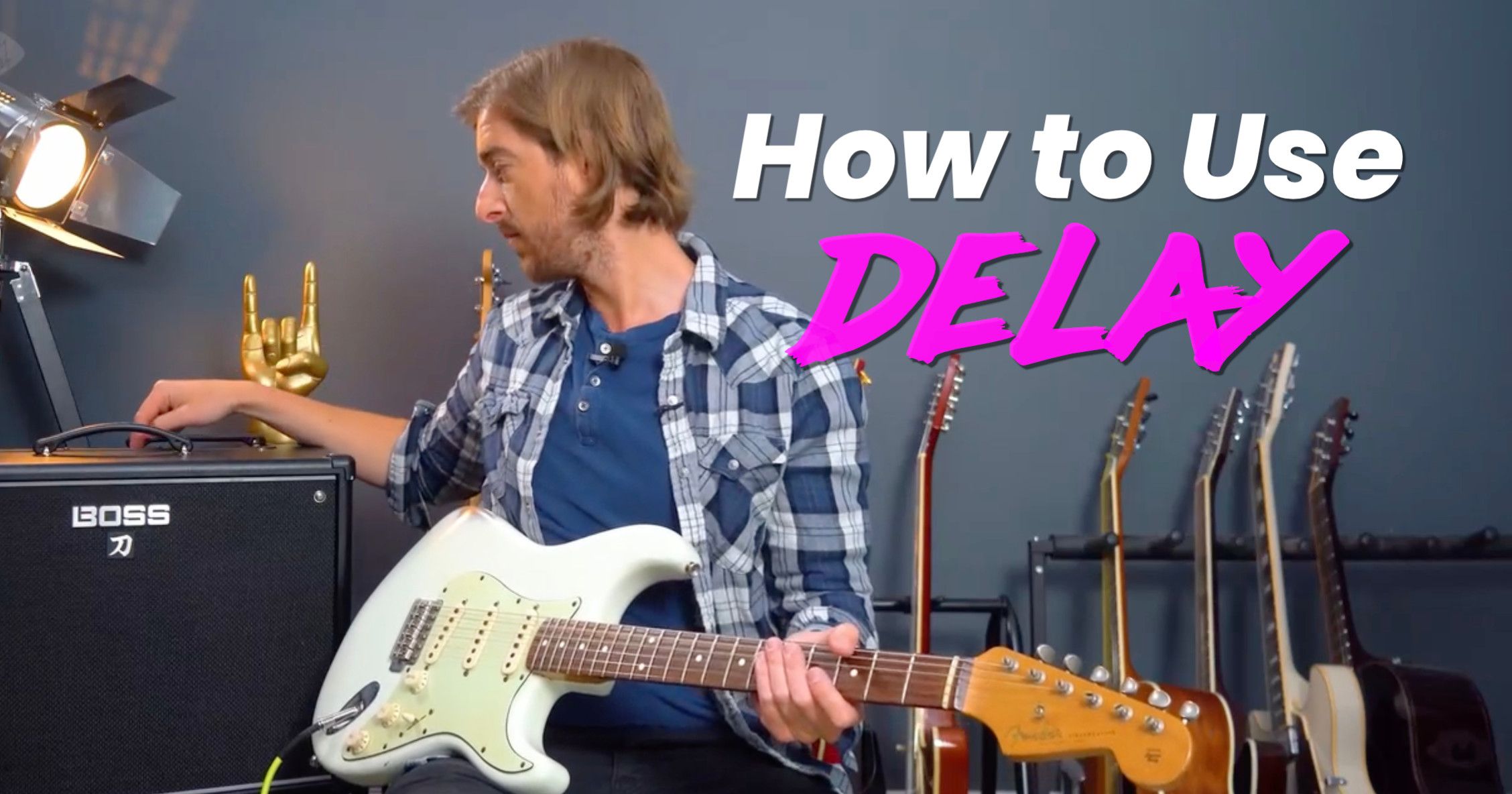
So I'm using the delay that's built in to the Boss Cortana, and the biggest thing that this has that we really need to make the most of having a delay um is a tap delay function, um which just allows us to set the length of the delay, so once we hear this first uh repetition and every repetition after that, we can govern the time of that. The er classic example of the shortest delay we can have, and if I just tap this button. Literally like that, pretty much as fast as I can tap, tap tap tap. There we go, this is called a slap back delay. Where we kind of hear it straight away and it gives us this surf guitar sound. That kind of thing. We can only really hear the delay when we uh, you know, play something that's short and sharp, something that we mute. If we strum a chord and let it ring out. Not hearing too much of the delay there. We, we need a short, sharp hit. So we can hear what that um echo is doing. The reverb that I wanna focus on in this lesson though is this triplet delay, which was absolutely made famous and um is the signature sound of the edge from U2. Now for that we need to get our head around this, what's commonly these days known as the dance hall rhythm. Think of Shape of You by Ed Sheeran. And if we think of the tempo of that. Bum bum bum bum bum bum. OK, that marimba rhythm is a very famous rhythm, and we need to be able to get our heads around it so we can put the tap tempo right, OK? So this is the BPM of the song, this is the uh tempo where the main count is, 1234. Now you don't need to be able to do this two at the same time, though it is a really good thing for your rhythm playing, but uh what we need to be able to do is tap that dun da da dun dun dun dun dun dun. OK, if we tap that to the BPM of the song that you're wanting to play, tap tap tap, we should get. Ta ta ta, we can't kind of get the delay of playing it for us, OK, and what that enables us to do is get these kind of crazy effects, so let me just double check, if we think about the uh rhythm of with or without you. Uh, by U2, bom bam bom bom bom bom bom bom bom, tap, tap, tap, dun dun dun dun dun dun. OK, I need to do it once, and then it's in there, and then we can suddenly play loads of U2 lines. It's a little bit faster. For where the streets have no name. And this has been used by so many guitarists since, uh, most famously, fairly recently in the hit song, uh Shut Up and Dance with Me. Those are just a few examples to show you the capability of going into the world of effects, but delay, most importantly, delay is a time-based effect. You need to set the right distance. Of each of the delays for the effect to be in place, um, so for this one, it's fairly easy, we're just gonna go for that again, du du du du. So if you have a tap delay, tap tap tap tap at that BPM and you will, you will get it, just copy exactly what you hear, tap when you want the delay to be heard, tap tap tap, tap tap, and you can do it. What we're gonna do is just play the open D string. But we're gonna mute it with palm mutin. Now usually parm mutin is like this. Kind of this rock kind of effect um to get chugs, but what we're gonna do is just pick. Just picking the open D string with palmm resting the outside of the palm of your hand on the strings here. And then what we're going to do, er if I just turn the delayer down so you can hear exactly what I'm playing. We're gonna play the open string. 4th fret with the 1st finger, 5th fret, and then 7th fret. Now here I want us to be aware of something called intervals, cause here we're playing the 1st, the 3rd, the 4th, and the 5th intervals of a major scale. The only one we're missing is the 2nd, that would be at the 2nd fret. 123. And frets wise, what we wanna play again is open, 4th fret, 5th and 7th. And yes, this sounds like, oh, when the Saints go marching in. Um, because it's, that's another major scale based melody using these same intervals. All we need to do is play these with palm muting. In a loop. It really doesn't sound like much on its own, but we had the delay, and all I'm gonna do now is just turn the effect up. Volume wise, there's my delay again. And it creates this iconic lead line. The downside is that when we play it slow, we can't really have the delay on cos it's not gonna create the right effect. If we play this really slow. It doesn't kind of sound as iconic, right? But we do want to just kind of gradually speed up to it. And then you find that sweet spot and you're aware. Um, the other notes that make up the riff. Uh, the second fret of string 50. on string 412. But the focus of this lesson absolutely wants to be playing open 45, and 7, and trying to get that sounding right with the delay. This is the best uh delay-based riff that we can go for. Close second, uh, would be. With or Without You by U2, I've got that in a separate video, so if you're interested in that lead line, it's a perfect one to go for as well. But let's try and get this cos it's probably easier and more useful cos we've got this idea of major scale intervals as well. So open, 4th fret, 5th, 7, with palm muting. Let's add the delay in, but make the delay uh just a little bit longer, so I'm gonna go tap, tap, tap, kind of that tempo, tap, tap, tap. Tap tap. And you can hear the speed that I play it at impacts how the delay, where the delay falls and therefore the effect that it gives. Um, so as I say, delay is a time-based effect and this is a hard one to do at a certain, you know, you can't, it's hard to make it sound right when we play it super slow, so we're aiming for a tempo. Kinda like that, dun dun dun dun dun dun dun dun. And that delay Tap, tap, tap, start with that riff, see how you get on with it slow, see if you can speed it up a little bit, and a key takeaway from this lesson is also the idea of intervals. Derived from the major scale where we can call notes or the notes of a major scale as numbers. So those numbers are the intervals. We'd just number the major scale 12345678, but we'd call them a second interval, major 3rd, perfect 4th, and perfect 5th.
In this video
I'm using the delay built into the Boss Katana, and the biggest thing we need is a tap delay function which allows us to set the length of the delay. The classic example of the shortest delay is a slapback delay where we hear it straight away, giving us this surf guitar sound. We can only really hear the delay when we play something short and sharp that we mute.
Triplet Delay
The delay I want to focus on is this triplet delay, which was made famous and is the signature sound of The Edge from U2. For that, we need to get our heads around what's commonly known as the dancehall rhythm - think of Ed Sheeran's rhythm patterns. That marimba rhythm is very famous and we need to be able to get our heads around it so we can put the tap tempo right. We need to be able to tap that down to the BPM of the song we're playing. Once we tap it in, the delay plays it for us, enabling us to get these crazy effects.
The Riff
We're playing the open D string with palm muting - resting the outside of the palm of your hand on the strings. We're going to play open, fourth fret with first finger, fifth fret, then seventh fret. Here I want to be aware of intervals - we're playing the first, third, fourth and fifth intervals of a major scale. The only one we're missing is the second at the second fret. This is another major scale bass melody using these same intervals.
Creating the Effect
We need to play these with palm muting in a loop. It really doesn't sound like much on its own, but when we add the delay and turn the effect up volume-wise, it creates this iconic lead line. The downside is when we play it slow we can't really have the delay on because it's not going to create the right effect. But we want to gradually speed up to find that sweet spot. This has been used by so many guitarists since.
Enjoying this video?
Try this course - Solid Intermediate Guitar
Level 6 completes Grade 4 — legato speed licks, major seventh chords, the Hendrix and Frusciante rhythm-lead style, and triads on the top three strings: the skills that finally let you see the whole neck.