E Minor Pentatonic Open Position Recap
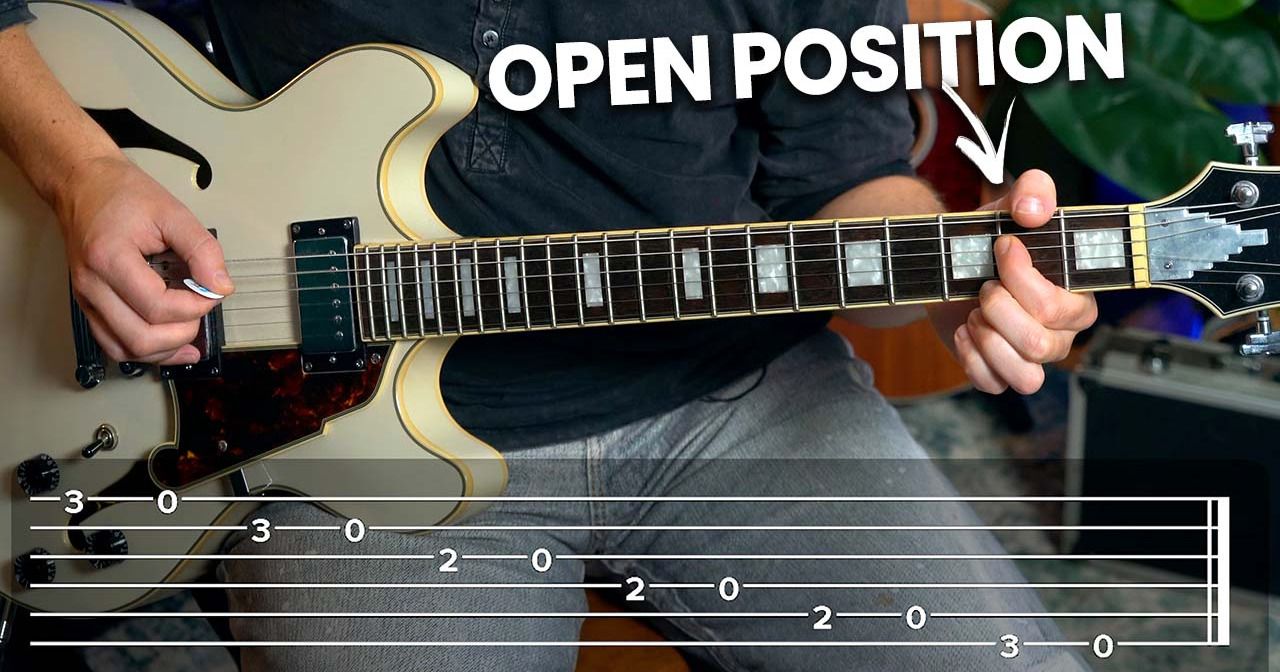
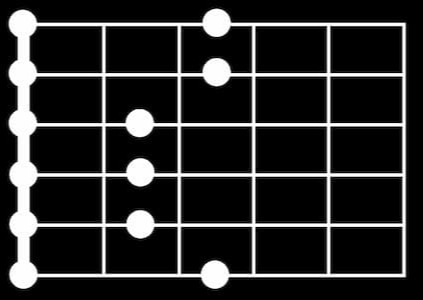
This video is a full recap of the E minor pentatonic scale in open position. When we looked at this in the previous module, I was really encouraging that we learn it one octave at a time. A recap over that is this, so open position means including open strings. And this is shape one of E minor pentatonic, the lower octave. Like that, and we said we've got a few riffs that we can play there, and then we have the thinner strings, which is the second octave. Which are where lead lines live, lead lines such as the intro to Hey Joe. We looked at that super easy way of playing it, we've got Johnny Kidd and The Pirates, uh this is shaken all over. And that's how we tend to use these, we use them one octave apart. Now to increase our skills, at this point, it's good to practise them one octave into the next seamlessly, just so that we can handle skills wise and picking wise that longer sequence of. Notes. So that's what I want us to practise in this level, and that would be, for example, very important that we're gonna do this now with down and up picking, so alternate picking, down, up, down, up, down, up per string. Like that, OK, let me demo this first of all. 34. That is one cycle. Now we ran through all of that in the previous level, but now's the time to check the detail. This is where the game is won and lost, it's not in learning a lot more notes, it's being able to play them better typically, and being able to play them faster and have everything sounding cleaner. So picking hand first of all, down and up picking, just alternate, per every string's really important. That will help us to be able to, to do it faster, there's a limit to how fast we can pick. Or with downs, and we can actually, I find I can go personally more than twice as fast. When I use down and up picking, so for example, thickest string. Like that's about as fast as I can do it. I'm not super fast if I just stick to all downs, but if I go down and up. That's where riffs such as Misaloo by Dick Dale. That's where those kind of riffs come in. Uh, we can't do those kind of riffs or get anywhere near that without doing down and up picking this. Although it seems like. Mundanely slow. Is how we build those skills and get them under our fingers. The next point is, fingers staying down and changing and lifting perceptibly at the same time. As we pick, so this is what we call the sink between the two hands, so what we don't want. Is this kind of thing. We actually want one note to last entirely up until the next note is played, and that means the slower you play, it's actually like zooming in, so we pick. Zoom in up on it by slowing down, and then when we pick and hit the middle finger down. That's zooming in. And we lift off, or press down with this hand and pick. At the same time. And we can only start to do that. When we're most of the time picking the right notes, hitting the right frets, and picking the right strings basically. So that's why we didn't introduce this in the first level. If that's a bit too much for you to go the whole um two octaves, bear in mind that the thicker strings are your riffs, so if you wanna get better at riffs, just cycle those lower ones and maybe try and build your speed there. You wanna get better at lead lines and things like, I don't know, coming up we've got rumble. You can go all the way, even things like uh Back in Black. We need that down and up. But if we're practising this as like a warm up to that, for the rest of Back in Black, it plays the thicker strings, so we wanna be. Not at that kind of speed. But that kind of consistency, consistency is the main thing. And again, we're looking at 4 times as a cycle. So this is how I want you to practise it, we'll have this clipped as a separate video down below with the tab on screen. Play along to that as your little practise routine to make sure we've got E minor pentatonic really sorted and just try and build your speed with this as you go. E minor pentatonic open position 4 times through as a cycle. 23. 4 Last but not least, to remember those notes, remember we actually said this is like a G major shape. So it's E minor pentatonic. But those are the same notes as G major pentatonic. It just depends which notes we start and finish on when it comes to a scale, so. That's G major pentatonic, those same notes but starting on the E. E minor pentatonic. Really good if we can put our pentatonic shapes to a chord shape to link them and realise that they're actually the same thing. More of that coming up later as we go through these lessons. That's your practise for E minor pentatonic for this module.
In this video
This comprehensive recap consolidates the E minor pentatonic scale across two octaves in Open Position.
We'll focus on building technical precision through alternate picking - down-up picks on every string - which is essential for increasing speed and developing an essential guitar technique.
Getting some fretting and picking synchronisation going, where both hands must work together seamlessly, is very important. If fretting and picking is like the steering wheel on a bus, then synchronisation is the engine! You literally can't go anywhere without an engine.
Main Learning Points:
• Complete a two-octave scale pattern (lower and higher octaves) which we call 'Open Position'
• Alternate picking technique for building speed (potentially doubling your picking speed!)
• Proper finger synchronisation between fretting and picking hands
• How the scale relates to the G major chord shape for visual memorisation
• Building consistency with four complete cycles as practice goal
• Applications in classic riffs: "Back in Black," and definitely "Rumble" by Link Wray
Beginner Electric Level 6
Recommended Songs
Enjoying this course? Want to test out your new skills? Find out my recommended song tutorials that accompany this course and get total access to the site by signing up today!